Thirty-six hundred is one of those numbers that quietly powers modern life — from internet speed tests to parking meters to workout timers. It is simple multiplication with surprisingly wide reach.
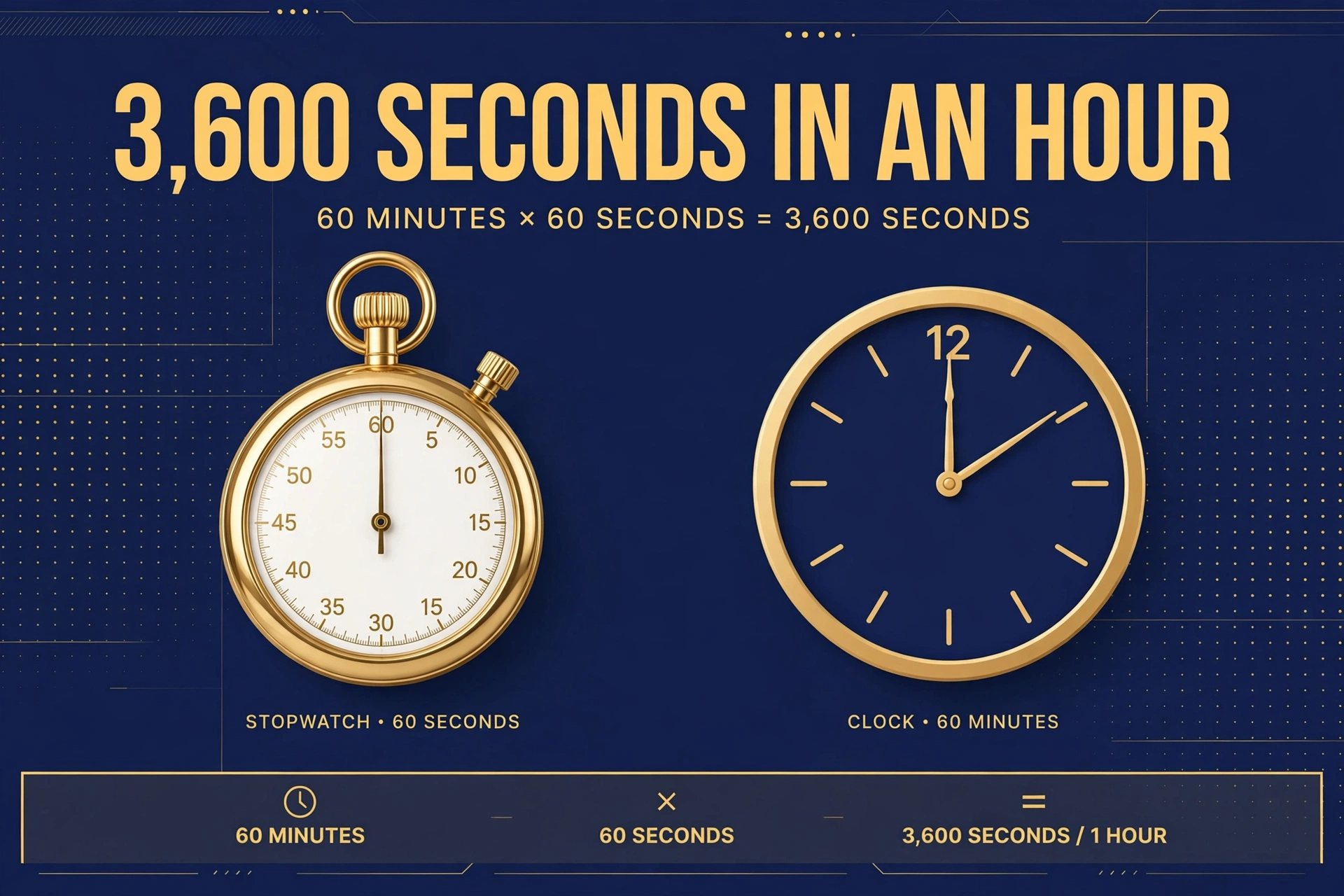
Quick Answer: 1 hour contains exactly 3,600 seconds (60 minutes × 60 seconds).
The Calculation
Each minute holds 60 seconds. An hour holds 60 minutes. Multiply: 60 × 60 = 3,600. Memorize it as 36 with two zeros, and the reverse is just as easy: divide any seconds figure by 3,600 to get hours.
Where 3,600 Shows Up
Internet speeds: megabits per second convert to hourly downloads via 3,600. Billing: freelancers and lawyers convert hourly rates to per-second or per-minute figures with it. Fitness: a 3,600-second workout is exactly one hour — many training plans are built in 3,600-second blocks. Official time standards behind units like these are tracked by NIST and explained for everyday use at timeanddate.com. Programming: session timeouts and rate limits are often set in multiples of 3,600.
Speed Math Tricks
Kilometers per hour to meters per second: divide by 3.6 (since 3,600 seconds ÷ 1,000 meters). So 90 km/h is 25 m/s. Seconds to minutes: divide by 60. Seconds to hours: divide by 3,600 — 7,200 seconds is exactly 2 hours.
Seconds in Time Periods
1 minute = 60 s. 1 hour = 3,600 s. Half day = 43,200 s. 1 day = 86,400 s. 1 week = 604,800 s.
Seconds in Work, Billing, and Sport
The 3,600-second hour quietly runs the working world. Lawyers and consultants who bill in six-minute increments are really billing in 360-second blocks, ten per hour. A full 8-hour workday contains 28,800 seconds; a 40-hour week holds 144,000.
Athletes live at the sharp end: world-class sprinters decide medals by hundredths of a second, and a marathoner’s pace is planned in seconds per mile across two-plus hours. Even your phone bills by this unit — data sessions, call durations, and screen-time reports all reduce to seconds before they round up to the hours you see. One hour, 3,600 identical pieces, endless uses.
Music gives the hour a friendlier face. A three-minute pop song is 180 seconds, so an hour holds about twenty of them back to back. A typical film runs close to two hours, or 7,200 seconds. And if you have ever watched a loading bar crawl, you have felt how long 60 of those seconds can seem — an hour simply stacks 3,600 of those small waits into the unit our whole day is scheduled around.
Quick converter: Skip the math with our free Seconds to Hour Converter — it handles every step of the ladder for you.
Conclusion
Sixty times sixty is 3,600 — one tidy number standing behind billing increments, bandwidth limits, training plans, and every timer you have ever set. An hour looks simple from the outside, but breaking it into seconds exposes how precisely the modern world slices time: lawyers by the 360-second block, athletes by the hundredth, networks by the millisecond hiding underneath.
You now hold the full ladder — 3,600 seconds in an hour, 28,800 in a workday, 86,400 in a day — and the reasons programmers, coaches, and accountants all count this way. Time is the one budget everyone shares. Spend its smallest units like you know their number.
Frequently Asked Questions
How many seconds are in an hour?
Exactly 3,600 seconds.
How many seconds in 2 hours?
7,200 seconds.
How many milliseconds in an hour?
3,600,000 milliseconds.
How do you convert seconds to hours?
Divide by 3,600.
Why is 3600 used in programming?
It is the standard seconds-per-hour constant for timers, timeouts, and rate limiting.