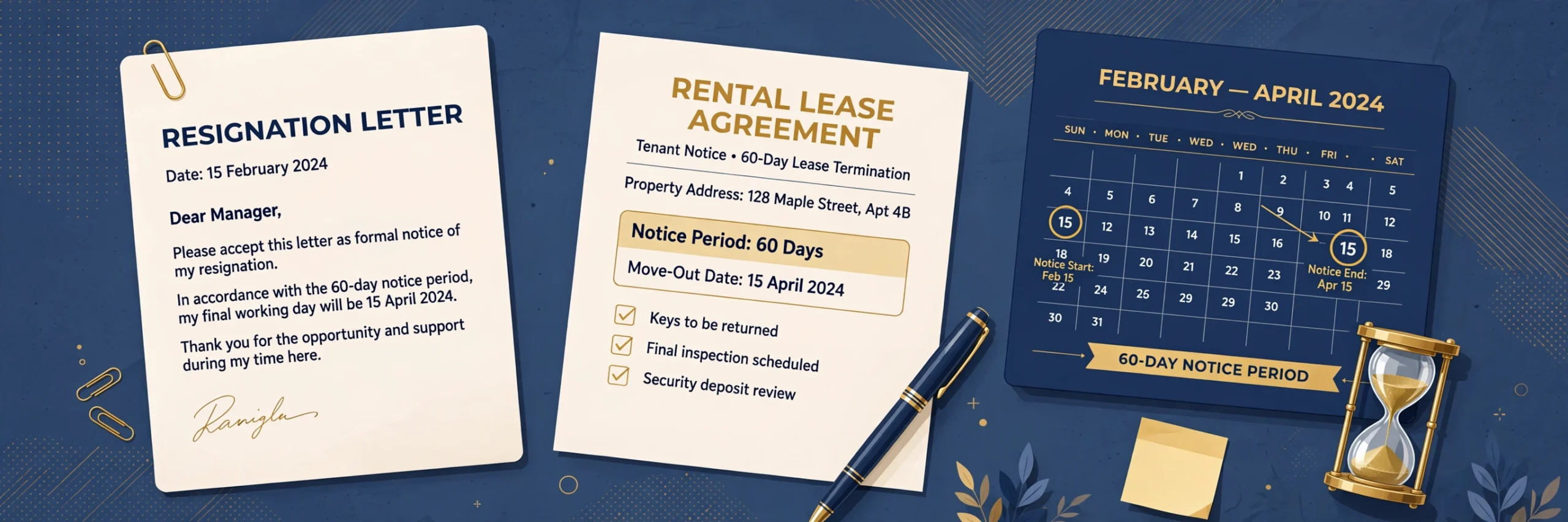
Sixty days sounds simple — count forward two months and you’re done, right? Not when the law, your landlord, or your client is involved. Google’s own search suggestions reveal the truth: people typing this query are really asking about 60-day notices and net-60 payment terms, questions where a single miscounted day can void a resignation, trigger a lease dispute, or delay your money by weeks. The three top-ranking pages all give you the same bare date and move on. This guide does what they don’t: it teaches you how to count correctly, what happens when day 60 lands on a weekend, and how to protect yourself for each type of deadline. Google’s own search suggestions confirm it: people typing this query are really asking about 60-day notices and net-60 terms — legal and financial questions with real consequences — which no ranking page answers.
Quick Answer: 60 days from today is the calendar date 60 days ahead. But if you’re giving notice — resignation, moving out, canceling — HOW you count decides whether your notice is valid.
What’s Your Deadline?
Different deadlines, different rules:
Giving Notice at Work
Check your contract first: does the 60 days start the day you deliver notice (day 1 = today) or the next day? Most US employment is at-will with no notice required — but if your contract demands 60 days, weekends usually count and the notice should be in writing with proof of delivery.
Moving Out (Tenancy)
Many leases require 60 days’ written notice before move-out. Critical details: notice often must be RECEIVED (not just sent) by the deadline, and some jurisdictions require specific delivery methods. If day 60 lands on a Sunday or holiday, deliver early — don’t gamble on the landlord’s interpretation.
Net-60 Invoicing
For freelancers and businesses: net-60 means payment is due 60 days after the invoice date. Clarify in your contract whether that’s 60 calendar days and what happens on late payment (late fees? interest?). Send the invoice the same day work completes — every day of delay is a day added to your wait.
Guarantees & Returns
60-day money-back windows are calendar days from purchase or delivery. Day 61 = no refund. Keep proof of the start date.
How to Count Correctly (The Off-by-One Trap)
The #1 mistake: is today day 1 or day 0? Legal counting usually excludes the starting day (day 1 = tomorrow), but many people include it — a one-day error that can invalidate notice. When in doubt, deliver one day early. Also clarify: do weekends and holidays count? For most contracts yes; for court/business deadlines, often no.
What Falls Inside Your 60 Days
Between now and your date: check for public holidays (they can shift business-day deadlines), your paydays (for financial planning), and any contract milestones. A 60-day window starting now crosses major holidays depending on the season — plan around them, not through them.
Business-Day Mode
If your deadline specifies business days: 60 business days ≈ 83 calendar days (about 12 weeks). Overlay US federal holidays for accuracy. When a deadline is ambiguous, the safer interpretation is the one that gives the OTHER party more time — courts tend to agree.
Conclusion
A 60-day deadline done right is completely forgettable — the notice lands, the invoice gets paid, life moves on. Done wrong, it becomes a dispute, a rejected resignation, or money stuck in limbo. The difference is rarely the date itself; it’s the counting: whether today is day zero or day one, whether weekends count, and what happens when day 60 falls on a Sunday. You’ve now got the rules for every scenario — resignation, tenancy, net-60, guarantees — plus the one habit that prevents nearly every 60-day disaster: deliver a day early and keep written proof. Count carefully, and this deadline will never surprise you.
Frequently Asked Questions
What is 60 days from today?
The date 60 days ahead — but for notices, confirm the counting rules first.
Does a 60-day notice include weekends?
Usually yes for contracts and tenancies; no for court/business-day deadlines. Check your specific agreement.
What is net 60 payment terms?
Payment due 60 days after invoice date — standard in B2B contracts.
What if day 60 is a Sunday?
Deliver early. Don’t assume the deadline rolls to Monday unless your contract says so.
How many weeks is 60 days?
8 weeks and 4 days.
Counting 60 days by hand is error-prone — the Days From Today Calculator does it instantly. Professional planners cross-check dates with tools like timeanddate.com‘s duration calculator.