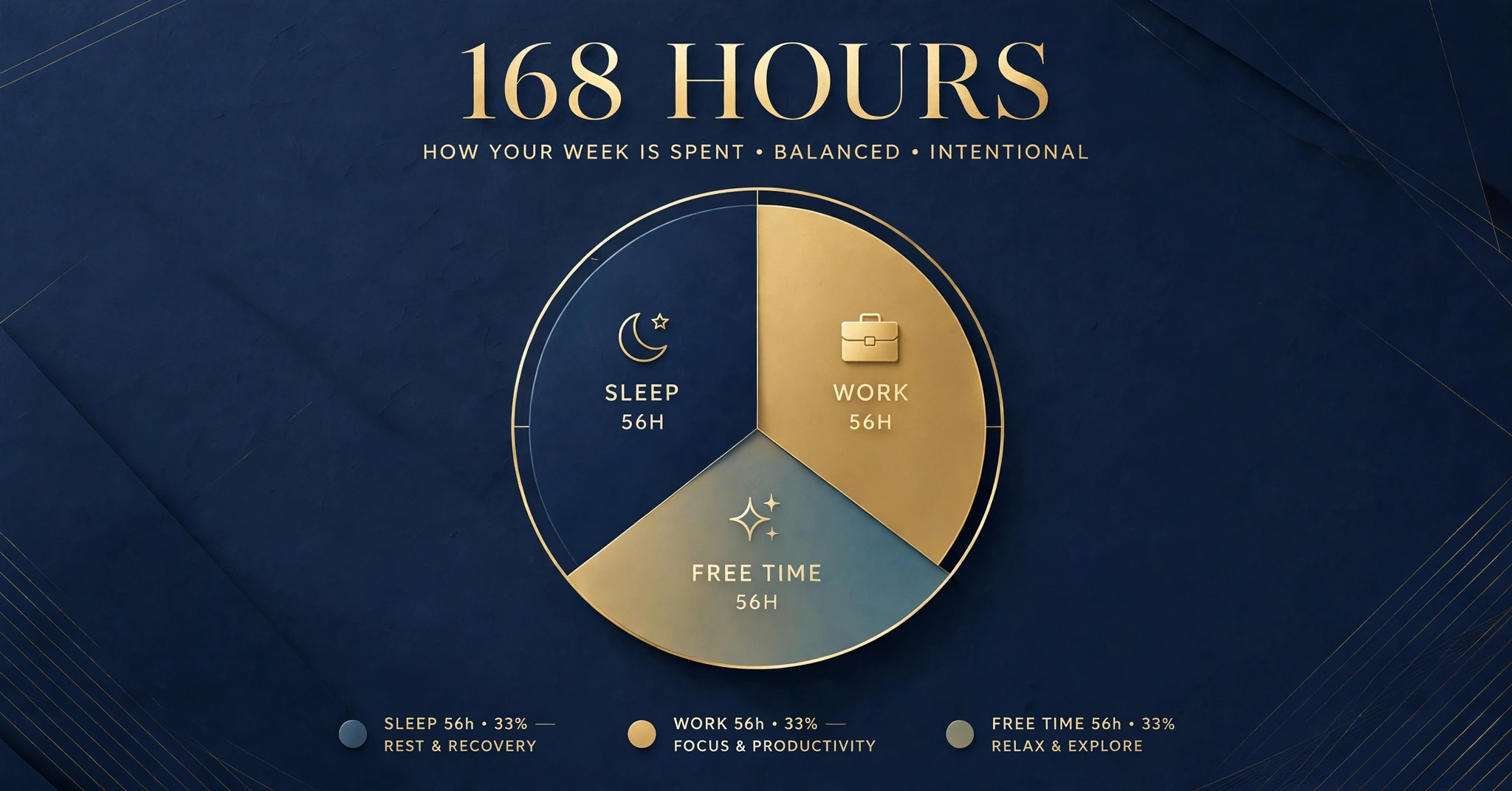
168 hours. That’s what you get every week — no more, no less, rich or poor. But here’s the angle nobody talks about: treat those 168 hours like a money budget, and suddenly time management gets very simple. This guide breaks down exactly where your 168 hours go.
The Math: 7 × 24 = 168
Seven days, twenty-four hours each. 7 × 24 = 168. It never changes — no leap weeks, no daylight-saving asterisks (the clock shifts, but the week still holds 168 hours). Memorize this number; it’s the foundation of every time calculation you’ll ever do.
Where Do Your 168 Hours Go? (The Budget)
Here’s the average adult’s weekly time budget. Prepare to feel surprised:
| Category | Hours/week | % of 168 |
|---|---|---|
| Sleep (8h/night) | 56 | 33% |
| Work (full-time) | 40 | 24% |
| Eating & personal care | 21 | 13% |
| Commuting (avg) | 5 | 3% |
| Truly free time | 46 | 27% |
Only 46 hours — about 6.5 per day — are actually yours. That’s the insight the 168-hour budget gives you: work isn’t eating “most” of your week (24%); the invisible costs (sleep, chores, commute) are.
Work Hours vs Total Hours
People searching “hours in a week” usually mean one of two things. Total hours: 168 (everyone). Work hours: typically 40 (full-time US), but it varies — France averages ~36, Netherlands ~32, and the OECD tracks them all. Part-time, overtime, and shift work change your personal number; the 168 never moves.
168-Hour Multiples (Quick Reference)
| Period | Hours |
|---|---|
| 1 day | 24 |
| 1 week | 168 |
| 2 weeks | 336 |
| 1 month (avg) | ~730 |
| 1 quarter | ~2,190 |
| 1 year | 8,760 |
The 168-Hour Audit: Find Your Leaks
Track every hour for one week — honestly. The average audit reveals: phone/social: 15–25 hrs, TV/streaming: 10–15 hrs, “waiting around”: 5–8 hrs. That’s 30–48 hours — nearly a full-time job — vanishing into low-value time. The audit isn’t about guilt; it’s about visibility. Most people who do it reclaim 5–10 hours/week permanently just by seeing the numbers. Your 168 hours are fixed; the audit shows you where they’re actually going versus where you think.
Overtime Math: What Extra Hours Really Cost
A 40-hour week leaves 128 non-work hours. A 50-hour week leaves 118 — but the felt loss is bigger, because overtime eats evenings, the highest-quality free hours. At 60 hours/week, you’re trading 20 of your best 46 free hours for pay. The math: each overtime hour costs you ~2.2% of your weekly free time. Whether that’s worth it depends on the rate — run it through our Overtime Pay Calculator to see the take-home reality.
Sleep: The 56-Hour Non-Negotiable
Eight hours/night = 56 hours/week — a full third of your 168. Cut to 6 hours and you “gain” 14 hours, but cognitive performance drops to the equivalent of legal intoxication within two weeks (per sleep-lab studies). The 14 “gained” hours are low-quality: slower, error-prone, irritable. No time budget survives cutting sleep — it’s the highest-ROI 56 hours in the week.
The 4-Day Week Math
A 4×10 schedule (four 10-hour days) keeps 40 work hours but reclaims a full weekday: 168 − 40 − 56 (sleep) = 72 non-work waking hours, with one completely free weekday for appointments that normally eat workdays. The 32-hour 4-day week (4×8) pushes free time to 80 hours — trials in Iceland and the UK found productivity held steady. The math says the 5-day week is a habit, not a law of physics.
ConclusionEvery week hands you exactly 168 hours — no more for the busiest executive, no fewer for anyone else. Sleep takes roughly 56 of them, work claims about 40, and what remains is the margin where health, family, and goals are either built or quietly postponed.
The number is not really trivia; it is a budget. Audit one ordinary week against the 168 and the leaks usually announce themselves — hours that felt like minutes, gone to things you would never have chosen on purpose. You cannot manufacture a 169th hour, but you can absolutely reassign the ones you already own.
>
Frequently Asked Questions
How many hours are in a week?
168 hours — 7 days of 24 hours each. This is fixed worldwide.
How many work hours are in a week?
The standard full-time week is 40 hours in the US (5 × 8). It varies by country and contract — always check yours.
How many hours are in 2 weeks?
336 hours (168 × 2). Biweekly pay periods cover 80 work hours.
Why 168 and not some rounder number?
It’s just 7 × 24 — the week inherited 7 days from ancient lunar calendars, and the day inherited 24 hours from Egyptian/Babylonian astronomy. Nobody designed it; it accumulated.
How can I get more free hours?
You can’t get more than 168 — but the budget table shows the levers: sleep is non-negotiable, so the wins are in commute, chores (batch them), and screen time (the average adult spends 30+ free hours weekly on screens).
Related Tools
- Hours Ago — what time was it N hours ago?
- Days Between Two Dates — plan in days