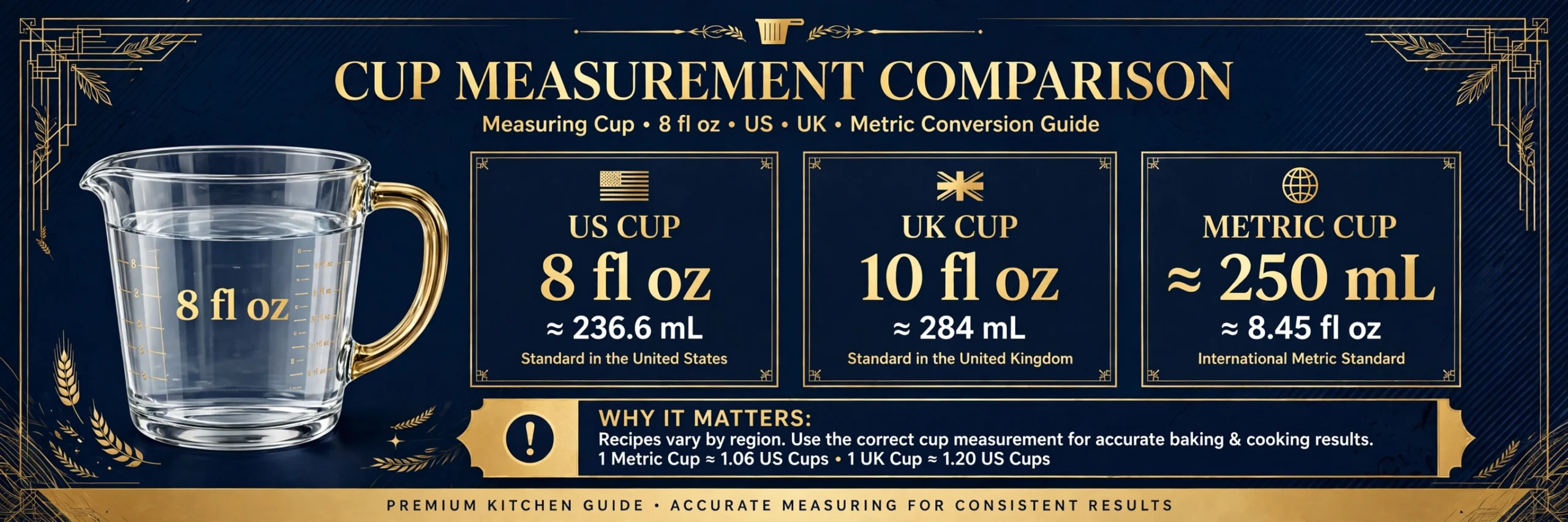
Ask a roomful of cooks how many ounces are in a cup and most will shout 8. They are right — in America. Cross the Atlantic or open an Australian cookbook and the answer changes. The confusion costs real recipes, so let us settle every version.
Quick Answer: 1 US customary cup equals 8 fluid ounces. But a UK imperial cup holds 10 fluid ounces and a metric cup holds 8.45 — the answer depends on your cup.
The Four Cup Standards
US customary cup: 8 fluid ounces (236.6 mL) — the American kitchen standard. US legal cup: 8.12 fluid ounces (exactly 240 mL) — used on US nutrition labels. Imperial (UK) cup: 10 imperial fluid ounces (284.1 mL) — the traditional British cup, noticeably larger. Metric cup: 8.45 US fluid ounces (exactly 250 mL) — used in Australia and much of the metric world. The official US measurement definitions behind these standards are maintained by NIST, the national authority for weights and measures.
Fluid Ounces vs Dry Ounces
This is the trap that ruins baking. Fluid ounces measure volume; dry ounces measure weight. One cup of water weighs about 8 ounces, but one cup of flour weighs only about 4.4 ounces while one cup of sugar weighs about 7.1 ounces. When a recipe says ounces for a dry ingredient, it almost always means weight — use a scale.
Quick Conversion Chart
Quarter cup is 2 fluid ounces. Half cup is 4 fluid ounces. Three-quarter cup is 6 fluid ounces. One cup is 8 fluid ounces. One and a half cups is 12 fluid ounces. Two cups is 16 fluid ounces, which is also one pint.
Weight Ounces vs Fluid Ounces: The Mix-Up That Ruins Recipes
The question hides a trap. A cup is a volume, but an ounce can be volume (fluid ounce) or weight — and they only match for water. Eight fluid ounces of water weigh about 8.3 ounces on a scale, close enough that nobody notices.
But a cup of flour weighs only about 4.25 ounces, a cup of honey weighs nearly 12 ounces, and a cup of cocoa powder barely reaches 3.5 ounces. When a recipe says “8 ounces of flour,” it almost always means weight, not a cup measure. Confuse the two and bread turns to brick. This is why serious bakers weigh ingredients and treat the cup as a backup.
A quick field test settles most arguments: fill a measuring cup with water to the 1-cup line and weigh it. You will see roughly 236 grams, which converts to about 8.3 ounces of weight for 8 fluid ounces of volume. Do the same with flour spooned loosely into the cup and the scale drops near 120 grams — proof, in one minute, that the cup measures space, not mass.
Try it: Convert any amount instantly with our free Grams to Cups Converter.
Conclusion
Eight fluid ounces per US cup is the headline, but the real lesson is to check which cup and which ounce a recipe means before you measure. American, British, and metric cups all differ, dry ingredients play by weight instead of volume, and the same word — ounce — describes two different things.
Get those distinctions right and recipes stop failing for mysterious reasons: the bread rises, the sauce thickens, and the cake matches the photograph. When precision matters, weigh your ingredients and let the gram be the referee. When speed matters, trust the 8-ounce rule for American liquids and measure on.
Frequently Asked Questions
How many ounces in a cup?
8 fluid ounces in 1 US cup. UK imperial cups hold 10 fl oz; metric cups hold 8.45 US fl oz.
Are fluid ounces and dry ounces the same?
No — one measures volume, the other weight. A cup of flour weighs ~4.4 oz, not the 8 oz of water it displaces.
How many ounces in half a cup?
4 fluid ounces (US).
Why do UK and US cups differ?
They come from different historical systems — the imperial system vs US customary — standardized at different sizes.
How many tablespoons in 8 ounces?
16 tablespoons, since 1 cup = 8 fl oz = 16 tbsp.