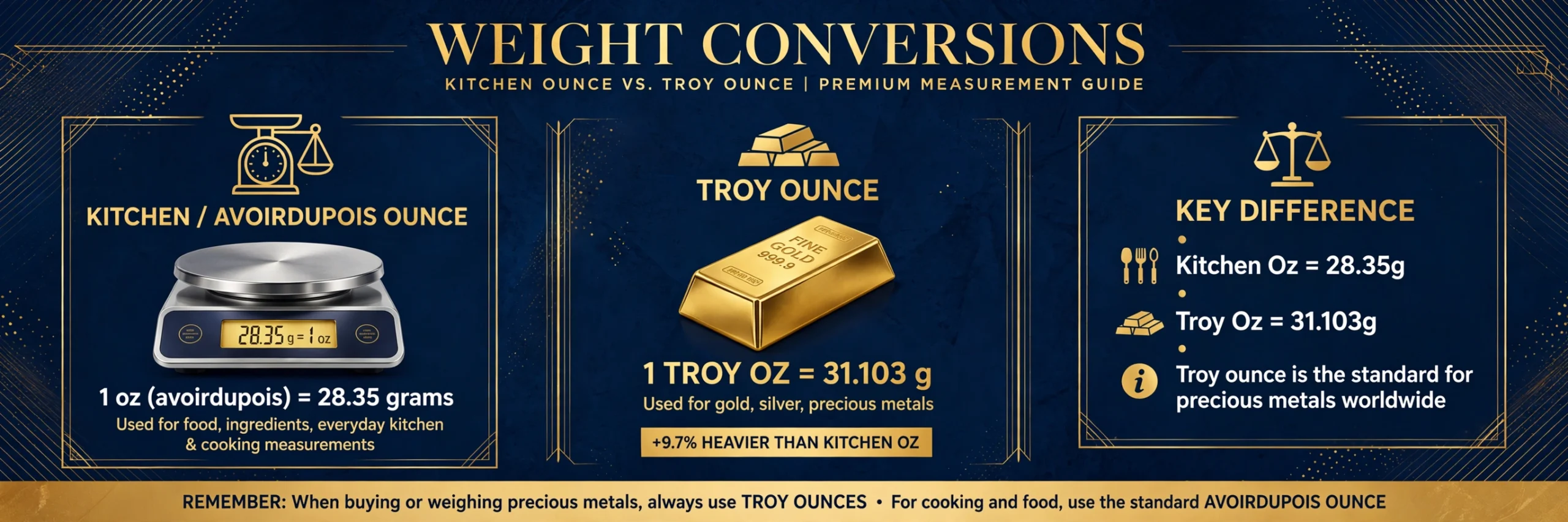
Two different ounces share one name, and mixing them up is expensive. A kitchen ounce and a gold ounce differ by nearly 10%. Here is how to never confuse them again.
Quick Answer: One avoirdupois ounce — the everyday ounce — equals exactly 28.3495 grams. But a troy ounce, used for gold and silver, equals 31.1035 grams.
The Everyday Ounce: 28.3495 Grams
The international avoirdupois ounce was fixed at exactly 28.349523125 grams by the 1959 international yard and pound agreement. Sixteen of them make a pound (453.59 grams). This is the ounce on food labels, in recipes, and at the post office.
The Troy Ounce: 31.1035 Grams
Precious metals are weighed in troy ounces — 31.1034768 grams each, about 2.75 grams heavier than the kitchen ounce. When gold is quoted at a price per ounce, that is always a troy ounce. Twelve troy ounces make a troy pound, a system jewelers inherited from medieval Troyes, France. Both ounce definitions are standardized under the guidance of NIST.
Quick Conversion Tricks
For everyday math, multiply ounces by 28.35. For a fast estimate, multiply by 28 (slight underestimate) or 30 (slight overestimate). Memory anchors: 1 oz is about 28 g, 4 oz is a stick of butter (113 g), 8 oz is half a pound (227 g), 16 oz is a full pound (454 g).
Ounces to Grams Reference
1 oz is 28.35 g. 2 oz is 56.70 g. 4 oz is 113.40 g. 8 oz is 226.80 g. 12 oz is 340.19 g. 16 oz (1 lb) is 453.59 g.
A Grams-to-Ounces Ladder for Real Amounts
Single conversions are easy to forget, so anchor the common ones. A quarter ounce is about 7 grams. Half an ounce is 14.2 grams. One ounce is 28.35 grams. Two ounces make 56.7 grams, four ounces (a quarter pound) make 113.4 grams, and eight ounces land at 226.8 grams.
A full pound is 453.6 grams. Coffee drinkers meet grams daily — a standard espresso dose is 18 grams, barely two-thirds of an ounce — while bakers flipping between American and European recipes jump this ladder constantly. Memorize just 28.35 and the pound anchor, and every step between them is simple multiplication.
Two more anchors cover most shopping. A slice of sandwich bread weighs about one ounce, so picturing a slice gives you 28 grams instantly. A AA battery is about 23 grams, just under an ounce. Meanwhile the troy ounce never appears in kitchens: it belongs to precious metals and old apothecary weights, and spotting the word “troy” on a listing is your signal to switch to 31.10.
Handy tool: Need the number fast? Use our free Unit Converter — instant results, no sign-up.
Conclusion
Twenty-eight point three five grams make a kitchen ounce, and 31.10 grams make the troy ounce that prices gold — keep the two systems straight and you will never misread a recipe or a bullion quote again. The ladder around them is just as useful: 14.2 grams in half an ounce, 113.4 in a quarter pound, 453.6 in a full pound.
Cooking, coffee, postage, and precious metals all cross this border between imperial habit and metric precision every day. Anchor on 28.35, convert with confidence, and the next time a European recipe meets an American scale, nothing gets lost in translation.
Frequently Asked Questions
How many grams in an ounce?
28.3495 grams for a standard (avoirdupois) ounce; 31.1035 grams for a troy ounce.
What is the difference between oz and troy oz?
Troy ounces (31.10g) are for precious metals; regular ounces (28.35g) are for everything else.
How many grams is 8 ounces?
226.8 grams — half a pound.
Is a fluid ounce the same as an ounce?
No. Fluid ounces measure volume; ounces measure weight.
Why are there two different ounces?
They come from different historical systems — avoirdupois for trade goods, troy for precious metals.