Four weeks per month is one of the most common math shortcuts in the world — and it is wrong eleven months out of twelve. The error seems tiny until it hits payroll, rent, or project planning.
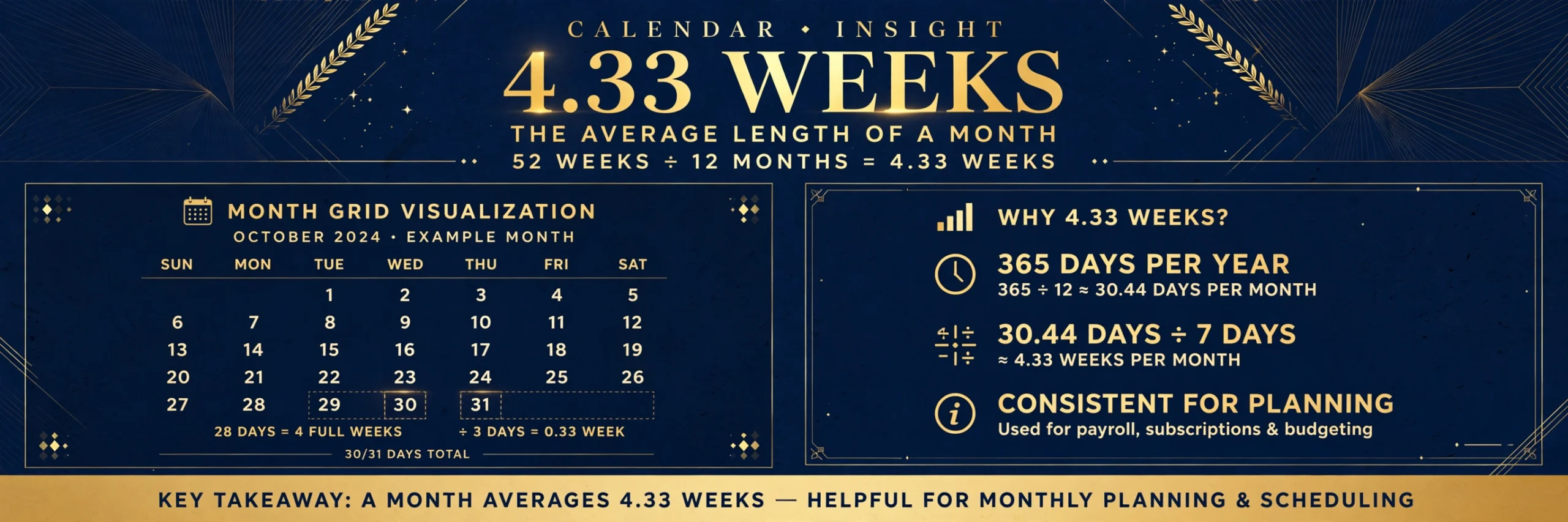
Quick Answer: An average month contains about 4.33 weeks. Only February in a common year has exactly 4 weeks; every other month has more.
The Real Numbers
February in a common year: 28 days, exactly 4 weeks. February in a leap year: 29 days, 4 weeks and 1 day. April, June, September, November: 30 days, about 4.29 weeks. January, March, May, July, August, October, December: 31 days, about 4.43 weeks. The average across the year: 4.33 weeks per month (52 weeks divided by 12).
Why the ‘4 Weeks’ Shortcut Hurts
Treating every month as 4 weeks undercounts the year by nearly 4.33 weeks — more than a full month of days. For payroll, that means monthly-paid staff effectively work extra days unpaid compared to weekly-paid colleagues. For budgeting, 12 × 4 weeks = 48 weeks leaves 4+ weeks of expenses unaccounted for. For project plans, a ’12-week quarter’ is actually about 13 weeks. Calendar data behind figures like these — month lengths, leap years, week counts — is catalogued in detail at timeanddate.com.
Weeks Per Month Quick Table
28 days = 4.00 weeks. 29 days = 4.14 weeks. 30 days = 4.29 weeks. 31 days = 4.43 weeks. Average month (30.44 days) = 4.35 weeks.
How Many Weeks in Each Specific Month?
The 4.33 average hides real differences month to month. February is the outlier: exactly 4 weeks in a common year (28 days) and 4 weeks plus 1 day in a leap year (29 days) — the only month that can be a perfect number of weeks.
Thirty-day months (April, June, September, November) run 4 weeks and 2 days, or 4.29 weeks. Thirty-one-day months (the other seven) run 4 weeks and 3 days, or 4.43 weeks. This is why payroll departments prefer semi-monthly pay over “every 4 weeks” logic, and why a “4-week month” in a budget quietly drops 1 to 3 days of spending every single month.
The same math explains the two-paycheck illusion. Workers paid every two weeks get 26 paychecks a year, which means two months contain a third paycheck — a bonus that only exists because months are longer than four weeks. Landlords, lenders, and subscription services all price by the calendar month for the same reason: 4.33 weeks is the honest divisor, and anyone quoting you “four weeks to a month” is rounding in their own favor.
Quick converter: Skip the math with our free Days Between Two Dates Calculator — it handles every step of the ladder for you.
Conclusion
Stop saying four weeks. At 4.33 weeks on average — 4 exact weeks in February, 4.43 in a 31-day month — the missing days add up to real money in payroll, real errors in project plans, and a phantom thirteenth month hiding inside every year of four-week budgets.
The fix is simple: count days, not shortcuts. Twelve months hold 52 weeks and a spare day or two, and any schedule built on 48 weeks quietly loses a month a year. Whether you are budgeting rent, planning a pregnancy, or setting a project deadline, the honest number is 4.33 — and now you know why.
Frequently Asked Questions
How many weeks are in a month?
On average 4.33 weeks. Only 28-day February has exactly 4.
How many weeks in a 30-day month?
About 4.29 weeks (4 weeks and 2 days).
How many weeks in a 31-day month?
About 4.43 weeks (4 weeks and 3 days).
Why isn’t a month exactly 4 weeks?
Because months have 28–31 days while a week is fixed at 7 days.
How many weeks in a year?
52 weeks plus 1 day (52.18 weeks on average).