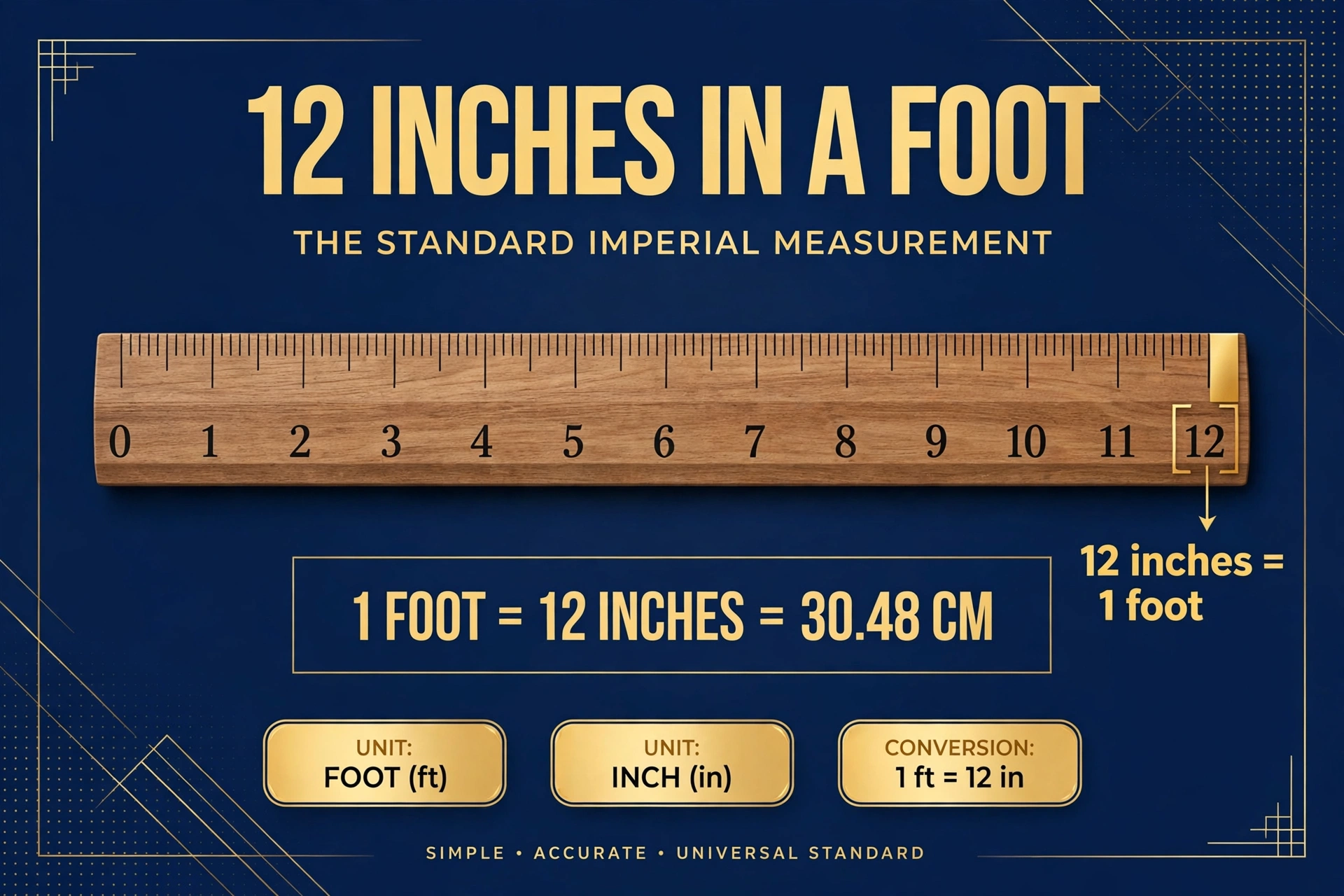
Twelve is one of the most memorable numbers in measurement, and the foot-inch relationship is the one everyone learns first. But why twelve? The answer stretches back to ancient body-based measuring.
Quick Answer: 1 foot equals exactly 12 inches.
Why Twelve?
Twelve divides evenly by 2, 3, 4, and 6 — far more useful than ten for splitting things into halves, thirds, and quarters. Ancient systems loved 12: 12 inches to the foot, 12 hours on the clock, 12 months in a year. The foot itself was literally based on the human foot, standardized over centuries until the international agreement of 1959 fixed it at exactly 30.48 cm. The 1959 agreement’s definitions are maintained today by NIST for the United States.
The 1959 Definition
Since 1959, one inch is defined as exactly 2.54 centimeters, making one foot exactly 30.48 cm. This international yard-and-pound agreement ended centuries of slightly-different feet across countries.
Conversion Formulas
Feet to inches: multiply by 12. Inches to feet: divide by 12. So 5 feet is 60 inches, 6 feet is 72 inches, and 100 inches is 8 feet 4 inches.
Feet–Inches Reference Table
1 ft = 12 in. 2 ft = 24 in. 3 ft = 36 in (1 yard). 5 ft = 60 in. 6 ft = 72 in. 10 ft = 120 in. A standard door is about 6 ft 8 in (80 in).
Feet and Inches in Everyday Heights
Twelve-to-one shows up most when people measure people. A person who is 5 feet 7 inches tall is 67 inches in total, or 170 centimeters. Six feet flat is 72 inches. The average American door is 80 inches — 6 feet 8. Ceiling heights run 8 feet (96 inches) in older homes and 9 feet (108 inches) in newer ones.
Screens play by the same unit: a 55-inch TV measures 55 inches diagonally, about 4 feet 7. Once you think of the inch as one-twelfth, mental math gets fast — a quarter foot is 3 inches, a third of a foot is 4 inches, half a foot is the familiar 6.
The dozen shows up in your living room too. Vinyl records are 12 inches across — exactly a foot. A standard sheet of letter paper is 11 inches long, one inch shy. Rulers sold worldwide often carry both scales, and the inch side is quietly split into halves, quarters, eighths, and sixteenths — fractions that stay manageable precisely because 12 divides so many ways. Decimal feet exist in surveying, but for everyone else, feet-and-inches remains the friendlier system.
Try it: Convert any amount instantly with our free Inches to Foot Converter.
Conclusion
Twelve inches to the foot is no accident — it is one of history’s most practical numbers, divisible by 2, 3, 4, and 6, still working beautifully thousands of years after thumbs and barleycorns set its size. That divisibility is exactly why it survived every attempt at reform: a third of a foot is a whole 4 inches, a quarter a whole 3, with no decimals trailing behind.
From heights and doorways to television screens and lumber, the dozen-based foot keeps mental math clean in a decimal world. You now have the anchors — 36 inches in a yard, 72 in six feet — and the reason behind them.
Frequently Asked Questions
How many inches in a foot?
Exactly 12 inches.
How many inches in 5 feet?
60 inches.
How many cm in a foot?
30.48 cm exactly.
Why is a foot 12 inches?
Twelve divides cleanly into halves, thirds, and quarters — ideal for construction and trade.
How many inches in half a foot?
6 inches.