Fuel prices, water jugs, aquariums, paint cans — the gallon-to-liter conversion shows up constantly in a metric world. The catch is that there are two gallons, and mixing them up means a 20% error.
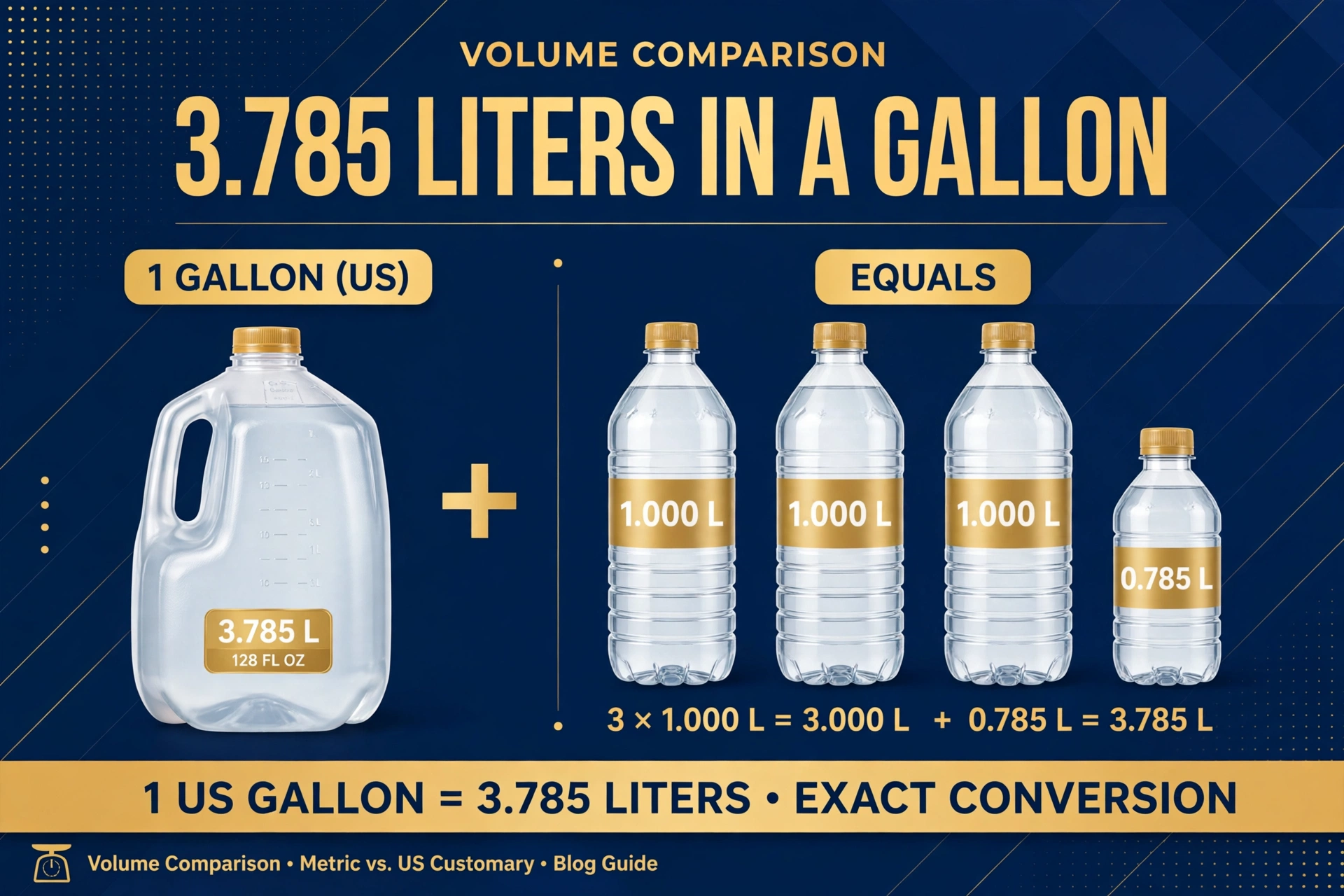
Quick Answer: 1 US gallon equals 3.785 liters. 1 UK imperial gallon equals 4.546 liters.
US Gallon: 3.785 Liters
The US liquid gallon is legally defined as 231 cubic inches, which converts to 3.785411784 liters — rounded to 3.785 for everyday use. A half gallon is about 1.89 liters, a quart about 0.95 liters.
UK Imperial Gallon: 4.546 Liters
The imperial gallon is defined as the volume of 10 pounds of water at 62°F, which is 4.54609 liters. Britain mostly uses liters now, but imperial gallons still appear in fuel economy figures (mpg) and older references. Both gallon standards, and their exact liter equivalents, are documented by NIST.
Everyday References
A US gallon of water weighs about 8.34 pounds (3.78 kg). A gallon milk jug is the classic visual anchor for 3.785 liters. Car fuel tanks in the US are usually 12–16 gallons (45–60 liters).
Conversion Formulas
Gallons to liters: multiply by 3.785 (US) or 4.546 (UK). Liters to gallons: divide by 3.785 (US) or 4.546 (UK). So 10 US gallons is 37.85 liters, and 20 liters is about 5.28 US gallons.
Why Fuel Economy Numbers Fool Travelers
The two gallons sabotage car comparisons. A car rated at 40 miles per gallon in Britain is burning imperial gallons, which are 20 percent larger — so the same car scores only about 33 mpg on American gallons.
Convert properly and the mystery vanishes: 40 UK mpg equals roughly 33.3 US mpg, and fuel volume follows the same split, with a UK gallon holding 4.546 liters against the US gallon’s 3.785. Rental-car travelers who fill a 50-liter tank in London have bought 11 imperial gallons; the same tank in Ohio holds 13.2 US gallons. Whenever a gallon crosses the Atlantic, ask which gallon it is.
Boats and swimming pools run on the same divide. American pool equipment sizes filters and chemical doses by the US gallon, while European manuals work in liters, so a dosing chart read in the wrong unit over- or under-treats the water by a fifth. The safe habit for any cross-border figure — fuel, water, paint, chemicals — is to convert to liters first, do the math once, and only then translate back if the equipment demands it.
Quick converter: Skip the math with our free Liters to Gallon Converter — it handles every step of the ladder for you.
Conclusion
Use 3.785 for US gallons and 4.546 for UK gallons — two numbers that end the confusion for good. Behind them sits a 20 percent size difference that quietly distorts fuel prices, car economy ratings, paint coverage, and recipe volumes whenever a gallon crosses the Atlantic unexamined.
The habit that protects you is simple: treat every gallon as guilty until proven local, check which standard a figure uses, and convert into liters when you need neutral ground. Liters never change their meaning at a border. Gallons always might. Keep both conversion anchors in mind, and no tank, tub, or tariff will ever surprise you again.
Frequently Asked Questions
How many liters in a gallon?
3.785 liters per US gallon; 4.546 liters per UK imperial gallon.
How many liters in half a gallon?
About 1.89 liters (US).
Why are US and UK gallons different?
The US kept the 1707 wine gallon; Britain redefined its gallon in 1824 around the weight of water.
How many gallons in 20 liters?
About 5.28 US gallons.
How much does a gallon of water weigh?
About 8.34 pounds (US gallon).