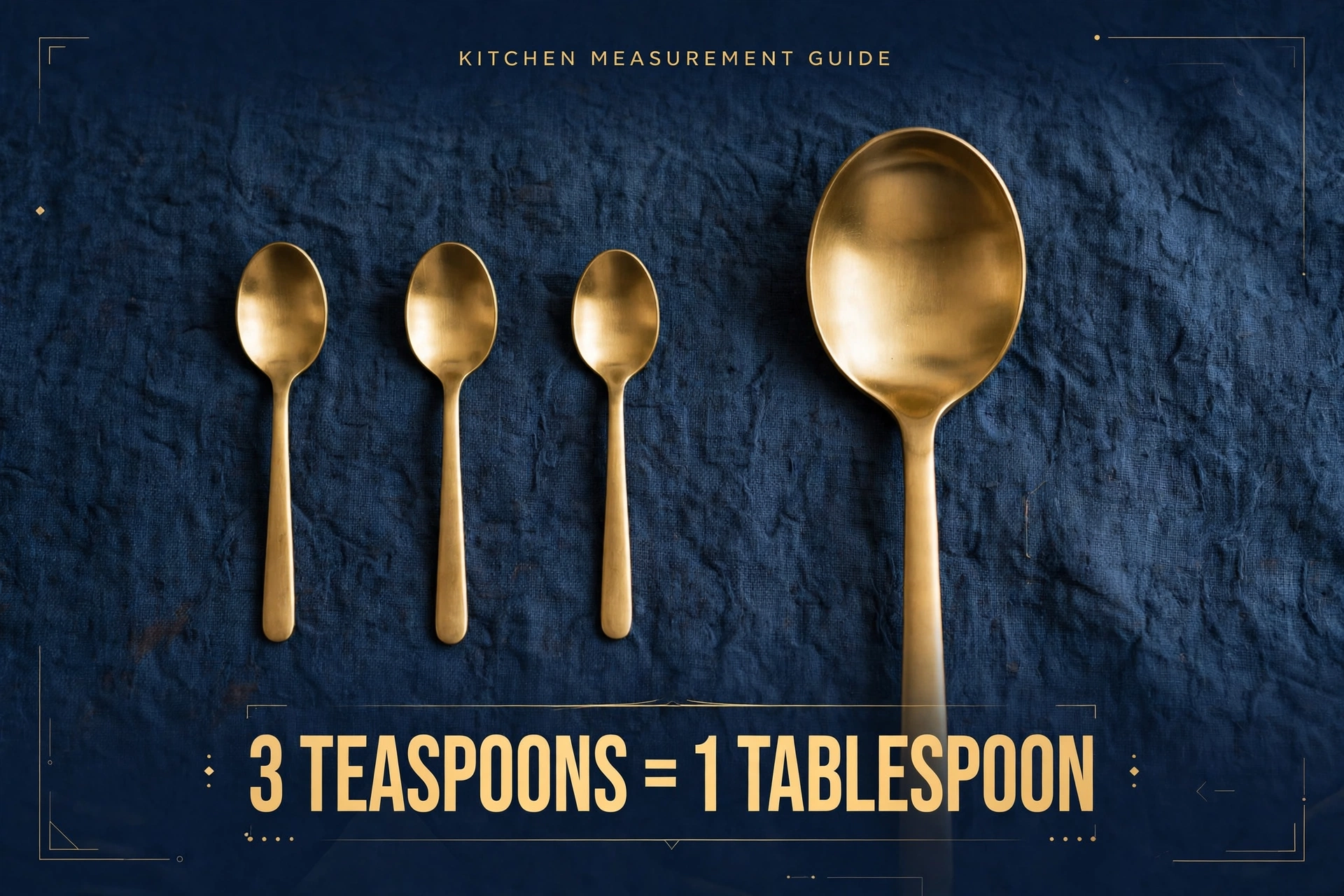
It is the single most useful ratio in the kitchen. Three teaspoons to a tablespoon — memorize it and you can scale any spice, extract, or leavening measurement up or down without a conversion chart.
Quick Answer: 1 US tablespoon equals exactly 3 US teaspoons (15 mL total).
The 3:1 Rule
One tablespoon holds three teaspoons. That means 2 tablespoons hold 6 teaspoons, and half a tablespoon holds 1.5 teaspoons. Going the other way: 9 teaspoons equal 3 tablespoons, which is just under a quarter cup.
Scaling Recipes Up and Down
Doubling a recipe that calls for 2 teaspoons of cumin? Use 1 tablespoon plus 1 teaspoon (4 tsp total). Halving 1 tablespoon of baking powder? Use 1.5 teaspoons. The 3:1 ratio makes the arithmetic painless. The 15 mL tablespoon and 5 mL teaspoon used in US labeling follow the measurement standards published by NIST.
Metric and UK Differences
The US tablespoon is 14.79 mL (legally 15 mL on nutrition labels). The UK tablespoon is traditionally 17.76 mL, and the Australian tablespoon is a full 20 mL — 4 teaspoons. For most home cooking the differences are negligible, but for baking precision, use the 15 mL standard.
Teaspoon–Tablespoon Chart
1 tsp = 1/3 tbsp. 2 tsp = 2/3 tbsp. 3 tsp = 1 tbsp. 6 tsp = 2 tbsp. 9 tsp = 3 tbsp. 12 tsp = 4 tbsp = 1/4 cup. 48 tsp = 16 tbsp = 1 cup.
Teaspoons All the Way Up: The Full Spoon Ladder
The 3-to-1 rule is one rung of a longer ladder. Three teaspoons make a tablespoon, 2 tablespoons make a fluid ounce, 16 tablespoons make a cup — which means a full cup holds 48 teaspoons. A pint is 96 teaspoons, a quart 192, and a gallon contains 768 teaspoons.
The ladder matters beyond cooking: medicine dosing lives on the bottom rung, where one teaspoon is standardized at 5 mL and one tablespoon at 15 mL. Studies of home dosing show kitchen spoons vary from 2.5 mL to over 7 mL, which is why pharmacists push the marked syringe: on this ladder, guessing is the one measurement that fails.
Baking chemistry is why the small rungs matter. A recipe’s teaspoon of baking soda is calibrated against cups of flour; swap in a tablespoon by mistake and the batter turns bitter and soapy, while a teaspoon where a tablespoon belonged leaves cakes flat. Precision at the bottom of the ladder protects everything stacked above it — which is why experienced bakers level spoons with a knife edge instead of eyeballing heaps.
Try it: Convert any amount instantly with our free Teaspoons to Tablespoon Converter.
Conclusion
Three teaspoons per tablespoon is the small ratio that unlocks the whole kitchen. It scales cleanly upward — 48 teaspoons in a cup, 768 in a gallon — and it standardizes downward into medicine, where a 5 mL teaspoon can be the difference between a correct dose and a guess.
The spoon in your drawer is a tool with a definition, not an approximation, and treating it that way fixes both baking failures and dosing errors. Level the spoon, remember 3-to-1 and 15 mL per tablespoon, and convert in either direction without a chart. Few numbers this small do this much work.
Frequently Asked Questions
How many teaspoons in a tablespoon?
Exactly 3 teaspoons per tablespoon (US).
How many tablespoons in 6 teaspoons?
2 tablespoons.
Is a tablespoon bigger in Australia?
Yes — the Australian tablespoon is 20 mL (4 tsp) versus the US 15 mL (3 tsp).
How many teaspoons in half a tablespoon?
1.5 teaspoons.
How many teaspoons in a quarter cup?
12 teaspoons (4 tablespoons).