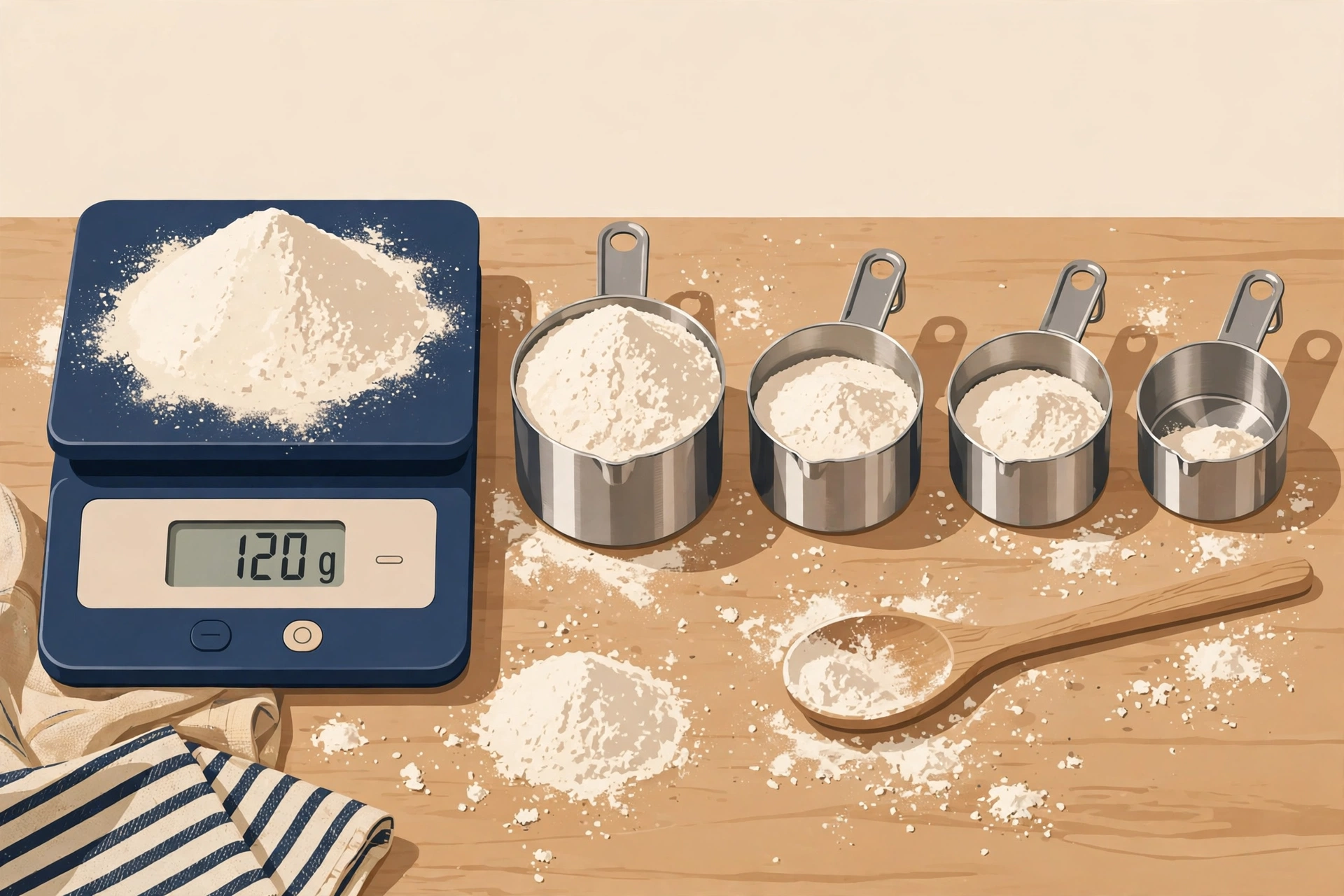
Here’s a kitchen experiment: type “100 grams of flour to cups” into three different converters. You’ll get three different answers — and not one of them will explain why. One assumes you spoon your flour (120g per cup), another assumes a different standard entirely (125g per cup), and a third might assume you scooped straight from the bag (closer to 150g). That’s a 25% swing from method alone, enough to ruin a cake. The dirty secret of every ranking converter page is that they each pick a method silently and present their number as gospel. This guide does the opposite: it shows you exactly why they disagree, teaches you to match the method to your kitchen, and gives you the tools to convert whole recipes with confidence. Try it yourself: three converters, one 100g of flour, three different answers — and none of them will tell you why.
Quick Answer: Converters disagree because they assume different measuring methods: spooned flour ≈ 120g/cup, scooped ≈ 150g/cup. Same grams, different cups — method is everything.
The Lab: Pick Your Method, Watch the Answer Change
Same 100g of all-purpose flour: SPOONED (fluff, spoon into cup, level) → 120g/cup → 0.83 cups. SCOOPED (dip cup directly into bag) → ~150g/cup → 0.67 cups. SIFTED → ~100g/cup → 1.0 full cup. One ingredient, one weight, three legitimately different answers — a 25% spread from method alone. Now add cup standards: US (236.6 mL), metric (250 mL), imperial (284 mL). The honest converter has toggles; the dishonest one has a single number.
Why Converters Disagree (Named and Sourced)
The flour discrepancy is public: gramstocup.com standardizes 120g/cup (spooned), thecalculatorsite.com uses 125g/cup. Both cite authorities (USDA, King Arthur). Neither is ‘wrong’ — they measured differently. King Arthur’s own data acknowledges the range. The scandal isn’t the disagreement; it’s that no converter TELLS you which method it assumes.
How to Measure It Right (Per Ingredient)
Flour: spoon and level, never scoop — scooping compacts up to 30% extra. Brown sugar: PACK it (the recipe assumes packed unless stated). Powdered sugar: spoon and level; sift if lumpy. Butter: 1 US stick = 113g = ½ cup; melted vs cold changes volume, not weight — weigh it. Cocoa: spoon and level like flour. Honey/syrups: weigh them; they’re too dense and sticky for cup accuracy.
Recipe Workspace: Convert the Whole Thing
Paste a full ingredient list and convert every line at once — then scale: ½× for testing, 2× for crowds, 3× for events. Scaling math: multiply every gram figure first, THEN convert to cups (converting then multiplying compounds rounding errors). Print the scaled recipe card for the kitchen counter.
Ingredient States Matter
‘1 cup chopped onions’ ≠ ‘1 cup onion purée’ — same ingredient, different preparation, different weight. ‘1 cup melted butter’ (227g) vs ‘1 cup cold butter, cubed’ (same weight, different volume behavior). Always note the STATE, not just the ingredient — this is where savory cooking conversions go wrong while baking guides stay silent.
Conclusion
The next time two converters disagree, you won’t have to guess who’s right — you’ll know they’re measuring differently, and you’ll know which method matches your kitchen. Spooned versus scooped versus sifted isn’t trivia; it’s a 25% swing in your flour, the difference between a perfect crumb and a brick. Weigh when it matters, match your cup standard to your recipe’s origin, scale in grams before converting, and always note the ingredient’s state. The most trustworthy converter was never the one with the biggest database — it’s the one honest enough to show its method. Now you can spot it instantly.
Frequently Asked Questions
How many cups is 100g of flour?
0.83 cups spooned (120g/cup), 0.67 cups scooped (~150g/cup), 1.0 cup sifted (~100g/cup) — method decides.
Why do converters give different answers?
They assume different measuring methods and cup standards without telling you.
Should I use US or metric cups?
Match your recipe’s origin: US recipes assume 236.6 mL; metric/Australian assume 250 mL.
Is weighing better than cups?
For baking, yes — grams eliminate the method problem entirely.
How do I scale a recipe?
Multiply gram weights first, then convert to cups — never convert then multiply.
Try it now in the Grams to Cups Converter. The gram itself is defined by NIST, the US authority for measurement standards.