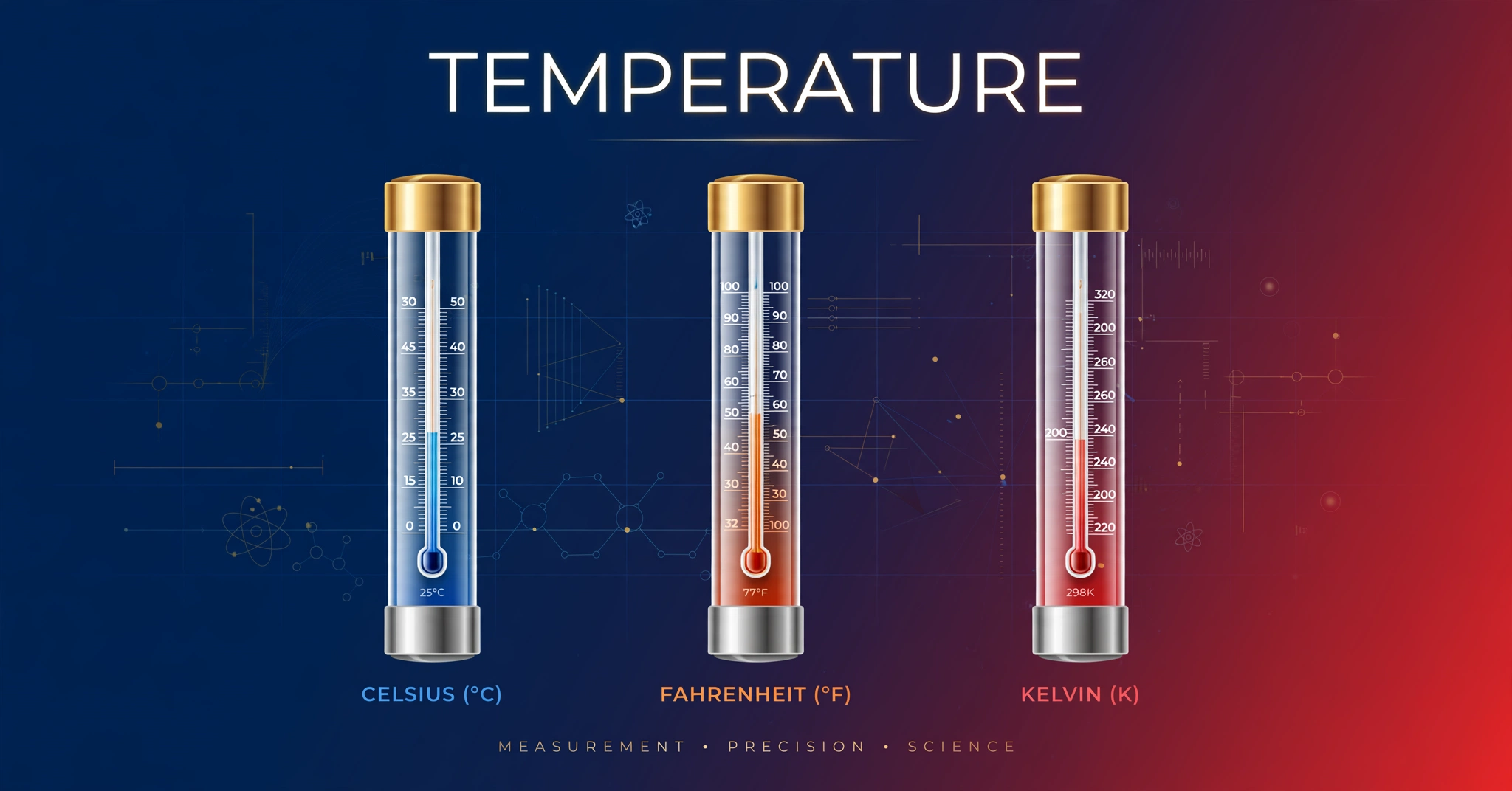
Three temperature scales describe the same physical reality — Celsius, Fahrenheit, and Kelvin are just three languages for heat. This guide is written for the switcher: the traveler landing in a Fahrenheit country, the American reading a European recipe, the student meeting Kelvin for the first time. Every formula between the three scales, plus — more usefully — how to think in each one without converting at all.
Three Scales, One Story
| Celsius | Fahrenheit | Kelvin | |
|---|---|---|---|
| Invented | 1742, Anders Celsius | 1724, D.G. Fahrenheit | 1848, Lord Kelvin |
| Water freezes | 0° | 32° | 273.15 |
| Water boils | 100° | 212° | 373.15 |
| Absolute zero | −273.15° | −459.67° | 0 |
| Used by | World (science + daily) | USA daily life | Science everywhere |
Every Conversion Formula
| From → To | Formula |
|---|---|
| °C → °F | °F = °C × 1.8 + 32 |
| °F → °C | °C = (°F − 32) ÷ 1.8 |
| °C → K | K = °C + 273.15 |
| K → °C | °C = K − 273.15 |
| °F → K | K = (°F − 32) ÷ 1.8 + 273.15 |
Learn to Think in Fahrenheit (Without Converting)
If you grew up on Celsius, stop converting and memorize the Fahrenheit landmarks instead: 32° = freezing, 50° = jacket weather, 68° = room temperature, 72° = pleasant, 86° = hot, 98.6° = body temperature, 100° = serious heat, 212° = boiling. That’s the whole weather vocabulary.
Within a week of referencing this list, “it’s 75° out” will feel like weather instead of arithmetic. The reverse works too — Americans visiting Europe should memorize: 0° = freezing, 10° = cool, 20° = pleasant, 30° = hot, 37° = body temp, 100° = boiling.
The Mental Math Tricks, Ranked
1. Double + 30 (°C → °F estimate): 20°C → 70°F (exact: 68°F). Error: ±2°F across weather ranges. 2. Subtract 30, halve (°F → °C estimate): 70°F → 20°C (exact: 21.1°C). 3. The 1.8 exact: for cooking and science, do the real formula — a 2° error ruins a soufflé. Full breakdown with practice examples in C to F in Your Head.
Fevers, Body Temperature, and When to Worry
Normal body temperature: 37°C = 98.6°F. A fever starts at 38°C = 100.4°F; 39°C = 102.2°F is firmly fever territory; 40°C = 104°F warrants a call to the doctor. The confusion trap: thermometers that switch scales. If your thermometer reads “37” and you’re not sure of the scale — 37°F would be near-freezing and obviously wrong, but a reading of “99” could be °F (mild fever) or a misread °C (fatal). Always check the unit on the device first.
Oven Temperatures: The Cook’s Conversion Table
| US (°F) | °C | Gas Mark | Use |
|---|---|---|---|
| 275°F | 140°C | 1 | Slow roasting |
| 325°F | 165°C | 3 | Casseroles, gentle baking |
| 350°F | 175°C | 4 | Cookies, cakes (the default) |
| 400°F | 200°C | 6 | Roasting vegetables |
| 425°F | 220°C | 7 | Crispy roasting |
| 450°F | 230°C | 8 | Pizza, searing heat |
Note the rounding: 350°F is exactly 176.7°C, but every recipe rounds to 175°C or 180°C. And fan/convection ovens run ~20°C hotter in effect — reduce the set temperature by 20°C (35°F) when converting a conventional recipe to fan.
Why Fahrenheit Feels More Precise (It’s Not an Illusion)
Between freezing and boiling, Celsius has 100 degrees; Fahrenheit has 180. That means 1°F is a smaller step than 1°C — weather in Fahrenheit genuinely carries more granularity. “It’s 72° vs 73°” is a meaningful distinction; “22° vs 23°C” is nearly 2°F of difference. This is the real reason Americans resist switching for weather: they’d lose precision in the range they care about most. For science, it doesn’t matter — instruments measure finer than either scale.
Extreme Temperatures: From Absolute Zero to the Sun
The coldest natural temperature on Earth: −89.2°C (−128.6°F), recorded in Antarctica. The hottest: 56.7°C (134°F) in Death Valley. Human survival range is narrow — sustained exposure above 35°C wet-bulb temperature is lethal regardless of fitness. At the other end, absolute zero (0 K = −273.15°C) is the theoretical floor where molecular motion stops; the coldest lab temperature achieved is a fraction of a billionth of a degree above it. And the Sun’s surface? 5,505°C — a number where the scale you use stops mattering.
When Is Each Scale Used?
- Celsius: daily life everywhere except the US; all science worldwide.
- Fahrenheit: US weather, cooking, and thermostats. Finer granularity makes weather feel precise.
- Kelvin: physics, chemistry, astronomy — anywhere absolute zero matters. Note: it’s K, never “°K”.
Deep Dives
- Celsius to Fahrenheit: Visual Guide — the formula with a real-world temperature ladder.
- C to F in Your Head — 3 mental tricks, ranked.
- Unit Converter — instant °C ↔ °F ↔ K.
Conclusion
Celsius, Fahrenheit, and Kelvin aren’t three different truths — they’re three dialects of the same language, and fluency beats translation. Memorize the landmarks (32° freezing, 98.6° body, 212° boiling), keep “double + 30” in your pocket for quick estimates, and use the exact formula when precision matters — the oven, the thermometer, the lab.
The switcher who thinks in landmarks instead of converting every number is the one who stops feeling foreign in a Fahrenheit country. Temperature is just a number with a story; now you can read it in all three scripts.
Frequently Asked Questions
What is normal body temperature in all three scales?
37°C = 98.6°F = 310.15 K.
Why does America use Fahrenheit?
Historical inertia — the US never completed metrication. Fahrenheit stuck for weather and cooking while science went Celsius/Kelvin.
Can temperature go below absolute zero?
No. 0 K (−273.15°C) is the theoretical floor — all molecular motion stops. The Kelvin scale starts there by definition.
Is a Kelvin degree the same size as a Celsius degree?
Yes. 1 K = 1°C in size; only the zero point differs. That’s why converting is just adding 273.15.
What’s the easiest C to F estimate?
Double the Celsius and add 30. 20°C → ~70°F (exact: 68°F).
What oven temperature is 350°F in Celsius?
175°C (exact: 176.7°C). Reduce by 20°C for fan/convection ovens.
At what temperature should I worry about a fever?
Fever starts at 38°C (100.4°F); call a doctor at 40°C (104°F) or if a fever persists beyond 3 days.