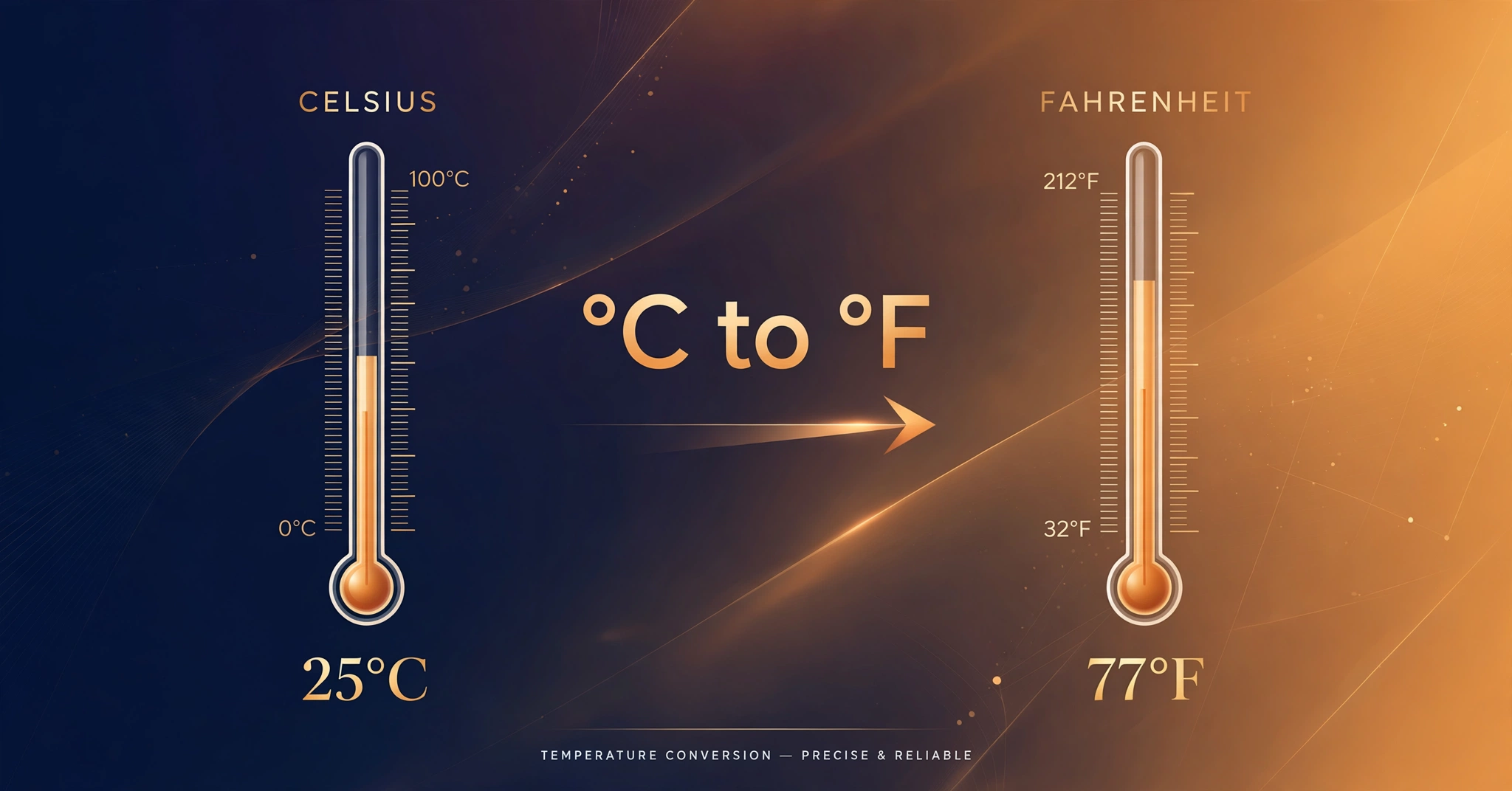
The formula is °F = °C × 1.8 + 32 — but memorizing symbols is forgettable. This guide makes it visual: a temperature ladder with real-world anchors, the formula walked through step by step, and the story of why 1.8 and 32. (Want speed instead? Try our mental-math tricks.)
The Formula, Step by Step
Convert 25°C:
- Multiply by 1.8: 25 × 1.8 = 45. (This stretches the Celsius degree to Fahrenheit size.)
- Add 32: 45 + 32 = 77°F. (This shifts for the different zero point.)
That’s it — stretch, then shift. Every C-to-F conversion is those two moves.
The Visual Temperature Ladder
Anchor these and you’ll rarely need the formula:
| °C | °F | What it feels like |
|---|---|---|
| -18 | 0 | Freezer |
| 0 | 32 | Water freezes |
| 10 | 50 | Chilly day |
| 20 | 68 | Room temperature |
| 30 | 86 | Hot summer day |
| 37 | 98.6 | Body temperature |
| 100 | 212 | Water boils |
| 180 | 356 | Oven (baking) |
Going Backwards: Fahrenheit to Celsius
Reverse the moves: °C = (°F − 32) ÷ 1.8. Unshift, then unstretch. Example: 86°F → (86 − 32) = 54 ÷ 1.8 = 30°C. Our Unit Converter does both directions instantly.
Why 1.8? Why 32? (The Story)
Water freezes at 0°C but 32°F — the scales start in different places, hence +32. And between freezing and boiling, Celsius counts 100 degrees while Fahrenheit counts 180: 180 ÷ 100 = 1.8. So every Celsius degree is “worth” 1.8 Fahrenheit degrees. Stretch (1.8), shift (32) — now the formula tells a story instead of just sitting there.
Common Conversions (Memorize These Five)
| °C | °F | Memory hook |
|---|---|---|
| 0 | 32 | Freezing — “32 is freezing” |
| 10 | 50 | Easy pair |
| 20 | 68 | Room temp |
| 30 | 86 | Hot day |
| -40 | -40 | The crossover — same both sides! |
When Precision Matters (and When It Doesn’t)
Weather: ±2°F error is invisible — use “double + 30.” Cooking: ±5°F matters for candy and bread; use the exact formula. Medicine: ±0.5°F can change a fever call; use a thermometer, not math. Science: always exact, and consider whether you should be in Kelvin instead. The rule: the higher the stakes, the less you estimate.
Reading Weather in Both Scales
Traveling? Memorize the weather landmarks in the other scale before you land. Celsius thinkers in the US: 50°F = jacket, 68°F = room temp, 86°F = hot. Fahrenheit thinkers in Europe: 10°C = cool, 20°C = pleasant, 30°C = hot. One glance at this list beats converting every forecast for a week.
The Full Conversion Table (Bookmark This)
| °C | °F | Feels like |
|---|---|---|
| -18°C | 0°F | Bitter cold |
| 0°C | 32°F | Freezing |
| 10°C | 50°F | Cool |
| 20°C | 68°F | Room temp |
| 30°C | 86°F | Hot |
| 37°C | 98.6°F | Body temp |
| 100°C | 212°F | Boiling |
Why 32? The Fahrenheit Origin Story
Fahrenheit set 0° at the coldest temperature he could make in his lab (a brine mixture) and 96° at human body temperature — later recalibrated so water freezes at exactly 32° and boils at 212°, making the interval a clean 180 degrees. The 32 offset is an artifact of that brine, not physics. Celsius, invented 18 years later, simply anchored 0 and 100 to water’s phase changes — which is why its formula needs no offset gymnastics beyond ×1.8.
Kelvin: The Third Scale in the Room
Scientists often skip both °C and °F for Kelvin — where 0 K is absolute zero (−273.15°C). Converting: K = °C + 273.15, so 20°C = 293.15 K. Kelvin matters because it’s an absolute scale: 200 K is literally twice as hot as 100 K (twice the molecular energy), while 20°C is not twice as hot as 10°C. Whenever a formula multiplies or divides temperature (gas laws, radiation), Kelvin is mandatory. Room temperature: 293 K. The Sun’s surface: 5,778 K.
Conclusion
Celsius and Fahrenheit describe the same world with different rulers, and the bridge between them is one short formula: multiply by 9/5, then add 32. Anchor points do the rest of the work — water freezes at 0°C and 32°F, boils at 100°C and 212°F, and the two scales meet at −40.
With those anchors in mind, weather forecasts, oven dials, and lab readings stop needing a phone to translate. Convert a few readings a day for a week and the scale you did not grow up with starts to feel native. Fluency in temperature, like any language, is just exposure plus a reliable formula.
Frequently Asked Questions
What is the formula to convert Celsius to Fahrenheit?
°F = (°C × 1.8) + 32, or equivalently °F = (°C × 9/5) + 32.
What is 25°C in Fahrenheit?
77°F (25 × 1.8 = 45, + 32 = 77).
Is there an easy way to estimate?
Yes — double the Celsius and add 30. 20°C → ~70°F (exact 68). Full tricks in our mental-math guide.
Why does the US still use Fahrenheit?
Historical inertia plus finer granularity — Fahrenheit degrees are smaller, so weather feels more precise (“72 vs 73” instead of “22 vs 23”). The Britannica has the full history.
At what temperature are Celsius and Fahrenheit equal?
-40° — the famous crossover point, same on both scales.
Related Tools & Guides
- Unit Converter — instant °C ↔ °F
- C to F in Your Head — 3 mental tricks