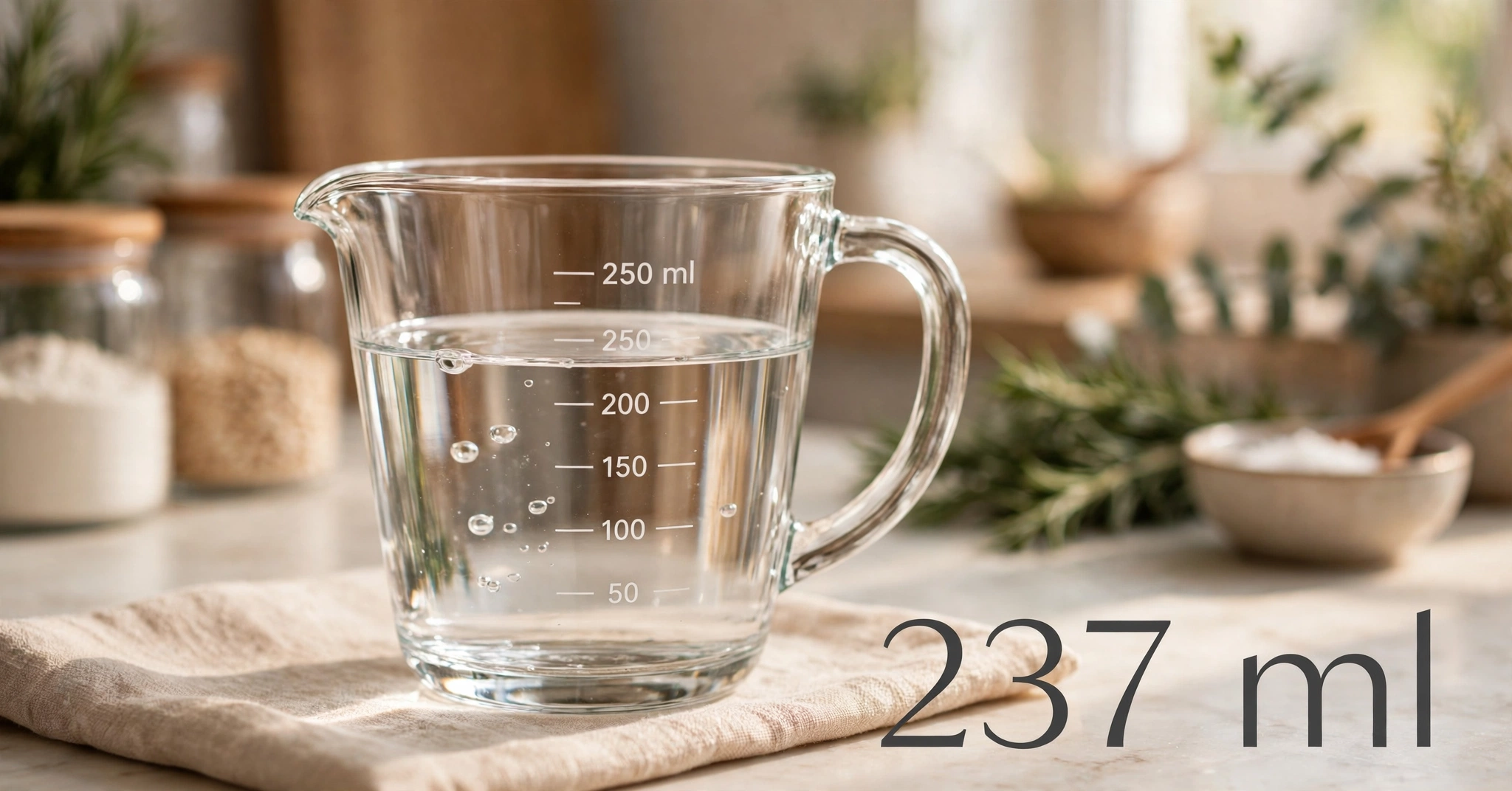
Ask “how many ml in a cup” and you’ll get three different answers — 237, 250, or 284 ml — and they’re all correct. The cup is the most confusing unit in cooking because four different standards share one name. This guide sorts them out once and for all.
The 4 Cups (Yes, Four)
| Standard | ml | Used in |
|---|---|---|
| US customary | 236.6 | American recipes (the default) |
| US food labeling | 240 | Nutrition labels |
| Metric | 250 | Australia, NZ, many metric recipes |
| Imperial (UK, pre-1970s) | 284 | Old British recipes |
The US customary cup is legally defined by the NIST as exactly 236.588 ml. The 13 ml gap between US and metric cups is small per cup — but across 4 cups of flour in a cake, it’s 50+ ml of liquid difference. Enough to matter.
Why So Many Cups? (30-Second History)
America standardized its cup in the 1800s from English wine measures; Australia later rounded to a clean 250 ml for metric sanity; Britain’s imperial cup (half a pint) was 284 ml but faded as the UK went metric. Nobody coordinated — hence the mess. When a recipe just says “cup” with no country, assume US (237 ml); Australian/British authors usually specify.
Which Cup Should YOU Use?
- American recipe? → 237 ml (US cup).
- Australian recipe? → 250 ml (metric cup).
- Grandma’s old UK cookbook? → 284 ml (imperial) — or just weigh it.
- Unsure? → For baking, weigh ingredients in grams and skip cups entirely. See our flour weight guide.
Cup to ml Conversion Table (US cup)
| Cups | ml | fl oz |
|---|---|---|
| 1/4 | 59 | 2 |
| 1/3 | 79 | 2.7 |
| 1/2 | 118 | 4 |
| 2/3 | 158 | 5.3 |
| 3/4 | 177 | 6 |
| 1 | 237 | 8 |
| 2 | 473 | 16 |
| 4 | 946 | 32 |
How to Measure ml Correctly
Liquids: use a clear measuring jug, read at eye level at the bottom of the meniscus (the curve). Under 15 ml: use measuring spoons, not a jug — the error margin on a 250 ml jug at 5 ml is enormous. Sticky liquids (honey, syrup): oil the measure first or weigh instead. Dry goods in ml: don’t — milliliters measure volume, and a “ml of flour” depends on packing. Convert to grams.
When Milliliters Beat Cups
Any recipe under 1 cup: 60 ml is more precise than “¼ cup” and scales cleaner (120 ml, 180 ml vs ¼, ½, ¾ cup fractions). Cocktails, baking chemistry (where 5 ml of lemon juice shifts pH), and medicine dosing all demand ml. The cup is a convenience unit; the milliliter is a precision unit. Professional kitchens use both — cups for speed, ml for accuracy.
Reading Labels: The 240 ml Trap
US nutrition labels define a cup as 240 ml, but the actual US cup is 236.6 ml — a 1.4% discrepancy baked into every American kitchen. For one recipe it’s nothing; across a production bakery it’s a rounding error that compounds. And “fluid ounces” on US labels (29.57 ml) vs the rounded 30 ml: same story. When a recipe and a label disagree slightly, this is usually why.
ml in Medicine: Where Precision Is Law
Medicine abandoned cups and spoons for milliliters decades ago — a child’s dose measured in a kitchen teaspoon can vary 3–7 ml, a dangerous swing for potent drugs. Oral syringes are marked in ml for exactly this reason. The lesson for cooking: whenever a recipe’s chemistry matters (baking powder, yeast, gelatin, rennet), measure in ml like a pharmacist, not in cups like a grandmother. Precision is a dial, not a switch — turn it up where failure costs most.
Conclusion
The cup is not one measure but four: 236.6 mL in the US customary system, exactly 240 mL on American nutrition labels, 250 mL in the metric world, and 284 mL in the old British imperial kitchen. Almost every failed recipe that “followed the instructions exactly” is hiding one of those swaps.
The fix is cheaper than the failures. Match the cup to the recipe’s country, weigh anything that truly matters, and treat the 240 mL label cup as the rounding convention it is. Once you know which cup you are holding, milliliters stop being a conversion problem and become the most reliable unit in your kitchen.
Frequently Asked Questions
How many ml is one cup?
236.6 ml for a US cup (rounded to 237). Metric cups are 250 ml.
Is 250 ml the same as 1 cup?
Only for metric cups (Australia/NZ). A US cup is 237 ml — about a tablespoon less.
How many ml in half a cup?
118 ml (US) or 125 ml (metric).
Why do US and metric cups differ?
The US cup descends from 19th-century English wine measures; the metric cup was rounded to 250 ml for decimal simplicity. Different histories, different numbers.
Should I just use grams instead?
For dry ingredients, yes — grams don’t have competing standards. For liquids, ml is equally unambiguous. Cups are convenient; grams/ml are accurate.
Related Tools & Guides
- Unit Converter — cups, ml, fl oz and more
- How Many Grams in a Cup of Flour? — weight vs volume