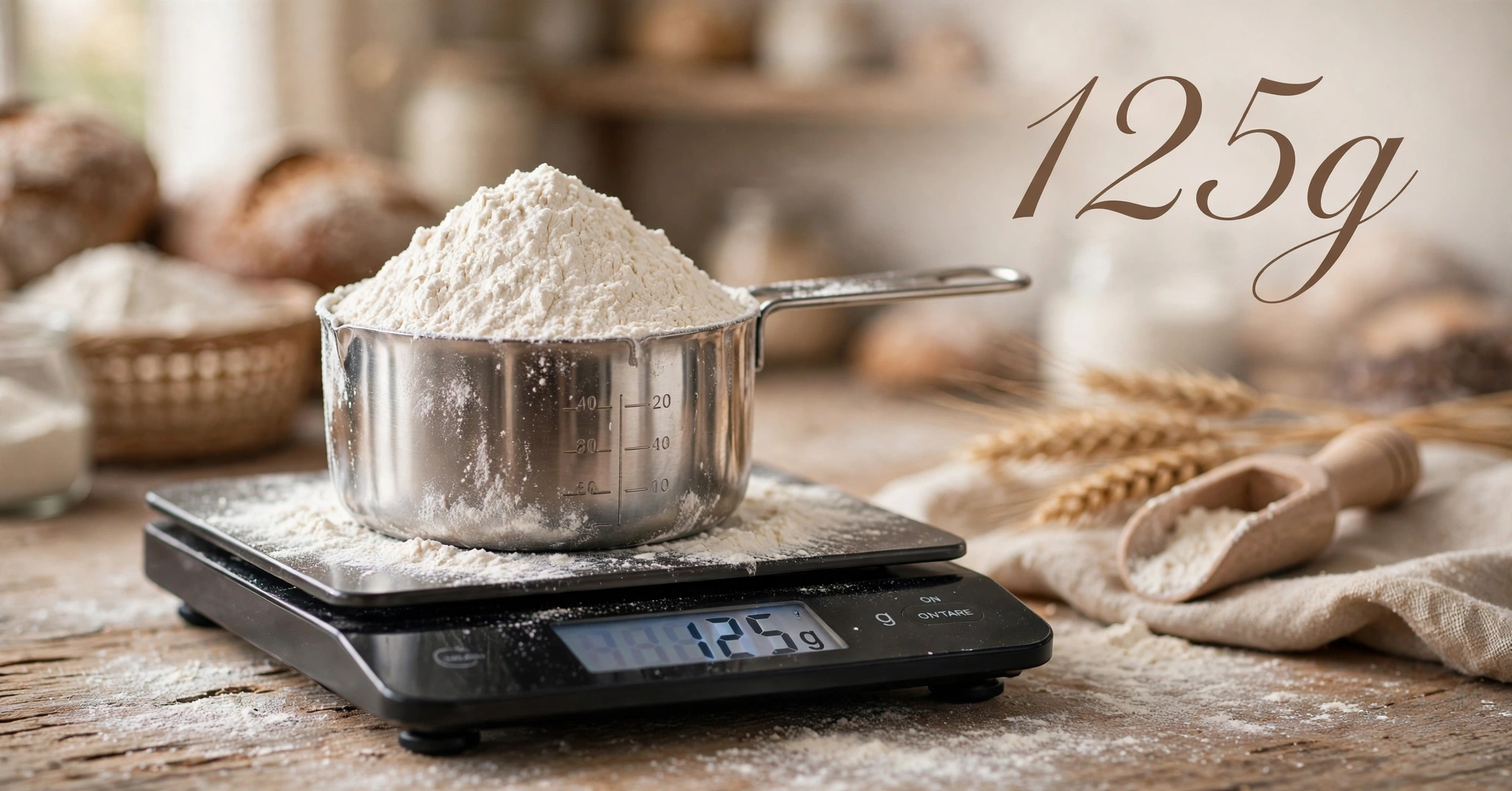
The honest answer: it depends — on the flour type and how you fill the cup. A cup of all-purpose flour is 120g spooned-and-leveled, but up to 150g if scooped straight from the bag. That 30g swing is the difference between tender cake and a brick. Here’s the full breakdown.
Why “It Depends”: The Scoop Problem
Flour compacts. Dragging your measuring cup through the bag compresses the flour, packing up to 25% more into the same volume. Professional bakers use the spoon-and-level method: spoon flour into the cup, then sweep a knife across the top. Even better: weigh it. A $15 kitchen scale eliminates the question entirely — and it’s why every serious baking recipe now lists grams first.
Grams per Cup by Flour Type
| Flour type | Spooned & leveled | Scooped |
|---|---|---|
| All-purpose | 120g | ~150g |
| Bread flour | 127g | ~155g |
| Cake flour | 114g | ~140g |
| Whole wheat | 113g | ~140g |
| Self-rising | 125g | ~150g |
| Rye flour | 102g | ~130g |
Worked Example: The 30g Mistake
A cake recipe calls for 2 cups of flour. Spooned-and-leveled: 240g. Scooped: ~300g — that’s 25% extra flour with the same liquid. Result: dry, dense crumb. This single habit explains most “I followed the recipe exactly!” baking failures.
Quick Conversions for Common Amounts (AP flour)
| Cups | Grams |
|---|---|
| 1/4 cup | 30g |
| 1/3 cup | 40g |
| 1/2 cup | 60g |
| 2/3 cup | 80g |
| 3/4 cup | 90g |
| 1 cup | 120g |
The Lab Test: Spooned vs Scooped vs Sifted
Same bag of all-purpose flour, three methods: spooned & leveled (fluff, spoon in, level): 120 g/cup. Scooped (dip the cup in the bag): ~150 g/cup. Sifted: ~100 g/cup. That’s a 50-gram swing — nearly half a cup of flour — from technique alone. Two people following the same recipe with different scooping habits are baking two different cakes. This is the #1 reason “I followed the recipe exactly!” still fails.
Why Your Cake Failed (The Flour Autopsy)
Dry and crumbly? Too much flour — you scooped. Dense and gummy? Too much flour and overmixed. Flat with no rise? Check leavening freshness, but also flour: old flour loses protein strength. Tough bread? Wrong flour type (AP instead of bread) or over-kneaded. In 4 out of 5 “bad recipe” complaints, the recipe was fine — the measuring wasn’t. Try any suspect recipe once more, weighed in grams, before blaming it.
The $10 Fix: How to Weigh Flour
Put the bowl on the scale, press tare, add flour to the gram target. That’s it — no cups, no leveling, no technique variance. A basic kitchen scale costs less than two bags of wasted flour. Professional bakers abandoned cups decades ago; the scale is the single highest-ROI tool in baking. Once you weigh, every recipe becomes repeatable — the same grams give the same cake, every time.
Flour Protein: Why Type Matters More Than Brand
All-purpose (10–12% protein), bread flour (12–14%), cake flour (7–9%) — protein is gluten potential, and gluten is structure. Swap bread flour into a cake recipe and you get chew where you wanted tenderness; swap cake flour into bread and it collapses. The gram weight differs per type too (bread flour packs denser at ~127 g/cup spooned). Match the flour to the job first, weigh it second — in that order.
The flour weights in this guide align with the USDA’s FoodData Central database, the standard reference for food weights and nutrition data.
Conclusion
A cup of flour is not a fixed weight — it is a range wearing a costume. Spooned and leveled all-purpose flour lands near 120 to 125 grams, while a scooped, packed cup can run far heavier, and that silent difference is behind more dense loaves and dry cakes than any oven fault.
The scale ends the argument permanently. Weigh flour at the standard for its type, write the gram number on recipes you repeat, and use the cup only as a rough guide for forgiving batters. Baking rewards precision more than almost any other cooking — and grams are how that precision is bought for the price of a ten-dollar scale.
Frequently Asked Questions
How many grams is a cup of flour, exactly?
120g for all-purpose flour using the spoon-and-level method. But “exactly” is doing heavy lifting — humidity, brand, and technique all shift it a few grams. For baking, a scale beats any cup.
Why do American recipes use cups instead of grams?
Tradition and convenience — volume measures need no scale. But the US is slowly converting: King Arthur and other major recipe sources now publish gram weights alongside cups because they’re more reliable.
Is a cup of flour the same as a cup of sugar in grams?
No — a cup of granulated sugar is ~200g, nearly double flour’s 120g. Cups measure volume; grams measure mass. Different densities, different weights. Never swap them 1:1.
Should I sift flour before measuring?
Only if the recipe says “1 cup sifted flour” (sift, then measure). “1 cup flour, sifted” means measure first, then sift. The order changes the weight by 10–20%.
What’s the easiest way to convert any recipe to grams?
Weigh your own cup once with your flour and your technique, write it on the recipe, and reuse it. Or use our Unit Converter for the standard values.
Related Tools
- Unit Converter — cups, grams, ml and more
- Percentage Calculator — scale recipes up or down