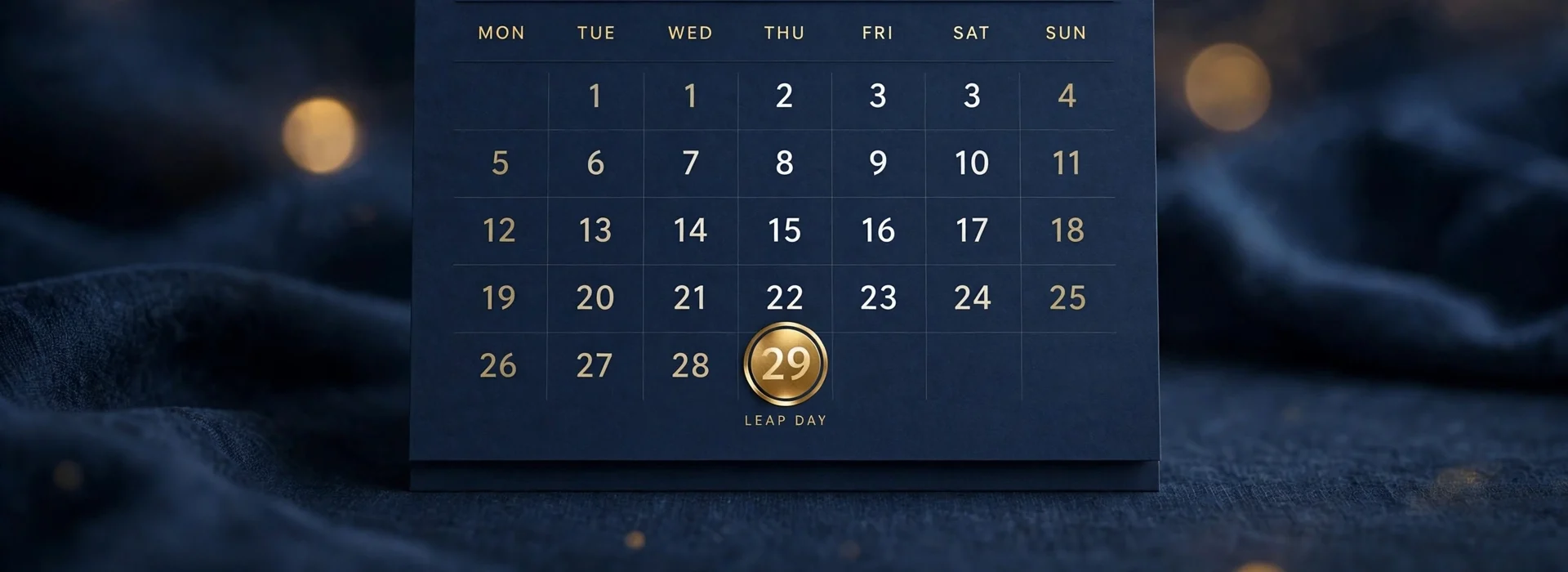
365 days in a common year, 366 in a leap year. But the interesting part is why — and the real leap-year rule, which is not “every 4 years” the way most people remember it.
The Real Leap-Year Rule (3 Parts)
- Divisible by 4? Leap year. (2024, 2028 ✓)
- …but divisible by 100? NOT a leap year. (1900, 2100 ✗)
- …but divisible by 400? Leap year after all. (2000 ✓)
So 2000 was a leap year, 1900 wasn’t, and 2100 won’t be. Most people only learn rule 1 — rules 2 and 3 are the fun part.
Why Do We Need Leap Years?
Earth takes about 365.2422 days to orbit the sun — not a neat 365. That extra ~0.2422 day per year adds up: without leap years, after 100 years the calendar would drift 24 days off the seasons. July would slowly slide into winter. The leap-day system keeps the calendar aligned to within one day per ~3,300 years. Good enough.
Why Does February Get the Extra Day?
Blame the Romans. The early Roman calendar had only 10 months starting in March, and February was the year-end dumping ground for calendar adjustments. When Julius Caesar reformed it in 45 BC, February — already the shortest month — kept the leftover day. Tradition stuck for 2,000+ years.
Days Breakdown
| Common year | Leap year | |
|---|---|---|
| Days | 365 | 366 |
| Weeks | 52 + 1 day | 52 + 2 days |
| Hours | 8,760 | 8,784 |
| Minutes | 525,600 | 527,040 |
| Seconds | 31,536,000 | 31,622,400 |
Business Days in a Year
A standard year has 260–262 weekdays; subtract ~11 US federal holidays and you get roughly 250 working days. That’s the number behind every “X per working day” calculation: a $65,000 salary ÷ 250 days = $260/day. Leap years add one weekday (261–263 total). If you’re planning PTO, the math that matters: 15 vacation days = 6% of your working year.
Days in Each Month
| Month | Days | Month | Days |
|---|---|---|---|
| January | 31 | July | 31 |
| February | 28 (29 leap) | August | 31 |
| March | 31 | September | 30 |
| April | 30 | October | 31 |
| May | 31 | November | 30 |
| June | 30 | December | 31 |
Memory trick: knuckles. Make a fist — every knuckle peak is a 31-day month, every valley is 30 (or 28/29 for February).
What 365 Days Can Actually Do
Compounded daily, a year is enormous: 20 minutes of daily practice = 121 hours (a university course); $5/day saved = $1,825; 1 page/day written = a 365-page book. The year isn’t 365 chances — it’s one chance, compounded 365 times. That’s why “days in a year” isn’t trivia; it’s the unit of every long-term plan you’ll ever make.
Leap Seconds: The Other Correction
Leap years fix the calendar; leap seconds fix the clock. Earth’s rotation is irregular, so since 1972 scientists have added 27 leap seconds to keep atomic time synced with solar time — the last at the end of 2016. A leap second makes a minute 61 seconds long, and it has crashed major websites (Reddit, LinkedIn, Qantas all stumbled on one). The plan: abolish leap seconds by 2035 and let the drift accumulate instead.
The 10,000-Day Milestone
10,000 days ≈ 27.4 years — a cult milestone in tech and personal development (the “10,000-day” career retrospectives). Your 10,000th day of life lands in your late twenties; many people use it as a sharper mid-life checkpoint than round birthdays. Calculate yours: birthdate + 10,000 days via our Days From Today calculator.
Why 365.25 Isn’t Quite Right Either
The Gregorian correction (skip century leap years unless divisible by 400) gets the year to 365.2425 days — but the true solar year is 365.2422. The remaining 26-second annual drift means the calendar gains one day every ~3,300 years. Proposed fix: skip the leap year in years divisible by 4,000 (the year 4000 won’t
The leap-year rules used here follow the Gregorian calendar — timeanddate.com explains why years divisible by 100 skip their leap day unless they are also divisible by 400.
Conclusion
Three hundred sixty-five days in a common year, 366 in a leap year — a rhythm set not by committee but by Earth’s orbit, tidied up by the leap rules of dividing by 4, skipping most centuries, and keeping the ones divisible by 400. Those small corrections are what keep the calendar glued to the seasons century after century.
Knowing the pattern pays off in ordinary places: interest calculations, subscription renewals, project timelines, and any countdown that crosses February. Check whether the year in front of you is a leap year before you count, and your day math will land exactly where you expect it to.
be a leap year under this proposal). Nobody alive will see it matter — but the math is already waiting.
Frequently Asked Questions
How many days are in a year exactly?
Astronomically, 365.2422 days (the tropical year). Calendars round this to 365 with periodic leap days to stay aligned.
Is 2026 a leap year?
No. 2026 ÷ 4 = 506.5 — not divisible by 4. The next leap year is 2028.
Why isn’t every 4th year a leap year?
Because the solar year is slightly less than 365.25 days. Skipping leap years on most century years corrects the overcount — that’s rules 2 and 3 above.
What happens to people born on Feb 29?
“Leaplings” celebrate on Feb 28 or Mar 1 in common years. Legally, most places treat Mar 1 as their birthday in non-leap years.
Do other calendars have leap years?
Yes, differently: the Hebrew calendar adds a whole leap month 7 times every 19 years; the Islamic calendar adds a day to the last month 11 times in 30 years.
Related Tools
- Days Between Two Dates — count any span
- Age Calculator — exact years, months, days